
Your service is required.
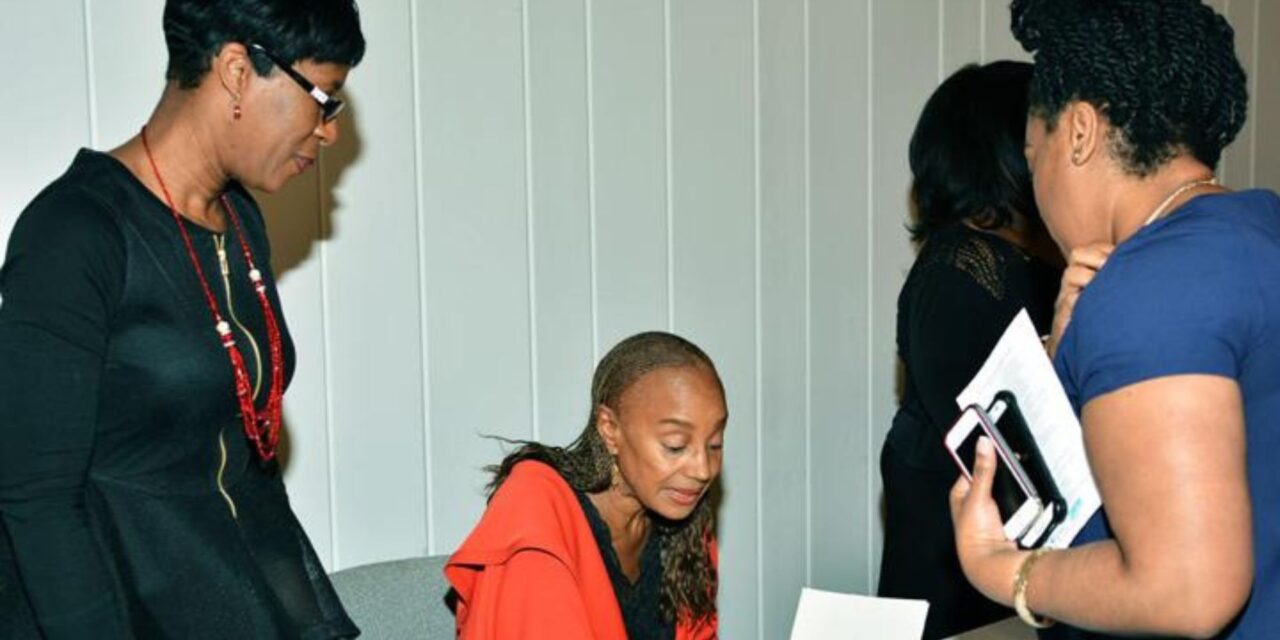
That was the message delivered by former editor-in-chief of Essence Magazine, Susan L. Taylor, during her keynote address at the Delta Sigma Theta Sorority, Inc., Minneapolis/St. Paul Alumnae Chapter’s 20th Annual Literary Luncheon. Taylor, who is also a bestselling author and founder of National CARES Mentoring Movement, said donating just one hour a week of one’s time can be transformative in arresting ills plaguing the Black community.
“Mentoring is truly my greatest calling,” said Taylor, who was with Essence almost from the start and took over as its editor-in-chief in 1981. “This (mentoring) is what I’m supposed to do. I’m on assignment and my assignment is to help those of us who are the least of us.”
Leading off her speech with a video of African-American celebrities including Oprah Winfrey, Mariah Carey, Sean “Puffy” Combs, Terrence Howard, Spike Lee and others reciting sobering – if not daunting – statistics about Black HIV/AIDS infection rates, homicide rates, high school dropout rates and more, Taylor said now more than ever, every able body needs to chip in.
“The village is on fire,” said Taylor. “And our challenge is we don’t have a plan. There is no national Black plan.”
Taylor laid deficits within the Black community squarely at the feet of the Black middle class, saying when Blacks moved to the suburbs they took their dollars and other key resources with them. She said visits by Black suburbanites to the inner cities are rare and without true, meaningful interaction.
“We (the Black middle class) moved out to the county and the only time we go back is to go to church,” said Taylor, who said once church service is over, many drive right back out to the suburbs without regard for those struggling in the neighborhood. “We ride to church, collect $20,000 for the pastor’s fund and children around the corner don’t even have books … don’t even have toilet paper. Come on, let’s wake up.”
Pointing to an example of volunteerism in East St. Louis, Ill. – a dangerous and impoverished almost exclusive African-American city – Taylor offered a concrete example how mentoring is transforming lives. She said an area church decided to adopt the freshman class at the area’s local high school, providing tutoring, life coaching and other support. She said that class eventually graduated 90 percent of its students. The class under it was also adopted by another local organization and it went on to graduate 98 percent of its class.
“Mentoring is a low-cost, high result way to change our condition,” said Taylor. “But when it comes to mentoring the first to respond are white women, then white men, then Black women, then finally Black men. We need mentors in reverse order.”
Presiding over Essence during its greatest time of growth, Taylor said the problems facing African-Americans are not beyond repair. She even recounted a time in her life where she was in despair but triumphed to become the national icon that she is today.
The luncheon that took place on April 9 at the Earle Brown Heritage Center in Brooklyn Center drew more than 300 attendees. Proceeds from the event went to fund high school scholars who were honored before Taylor’s speech. Recipients of the scholarships of between $1,000 and $5,000 were Samuel Adeniyi of Roseville Area High School; Breanna Baylis, a senior at North Community High School; Kalid Dalu, Park Center High School; Callie Glanton, a senior at Irondale High School; and Dede Quevi, Edina High School.
Insight News served as media sponsor for the event.