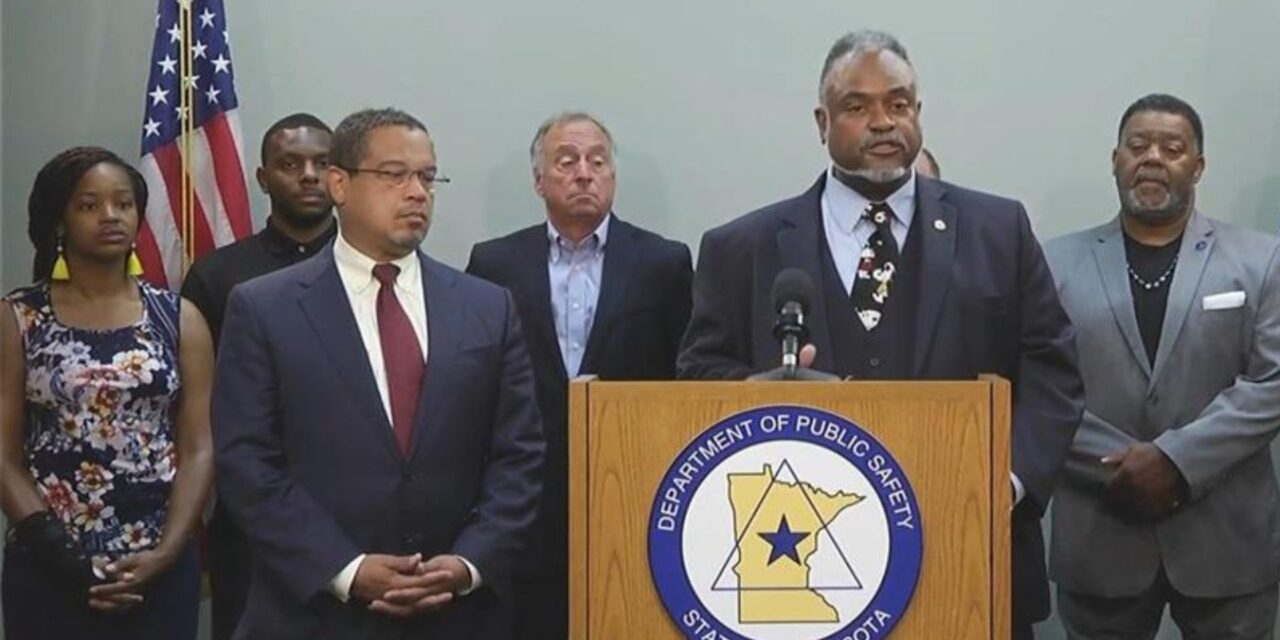
In the wake of several high-profile police shootings in Minnesota – in particular, those of Jamar Clark, Philando Castile and Justine Ruszczyk (Damond) – Minnesota Public Safety Commissioner John Harrington and Attorney General Keith Ellison announced the formation of a working group to address the issue.
Harrington and Ellison will serve as co-chairs of the 16-member body, which is made up of both members of the community and law enforcement. The group will solicit statewide feedback and convene a series of hearings on prevention and training, community healing and officer wellness, policy and legal implications and investigation, oversight and accountability. The community meetings will take place Aug. 17, Sept. 28 and Oct. 17 at yet-to-be-announced locations. Harrington said the discussion of this working group has been ongoing since he assumed his role at the beginning of the year.
“As a cop for 40 years, I learned that the time to create a partnership wasn’t in the middle of the crisis and the time to discuss deadly encounters is not after one has occurred,” said Harrington during a July 22 press conference to announce the working group. “We want to know how do we, as a state, reduce deadly force encounters.”
Harrington said the working group will evaluate all input to come up with a best practices framework to reduce officer involved shootings and on how to investigate once one has occurred.
“We’re looking at everything from top to bottom,” said Harrington. “We’re looking at state and local changes, legislative initiatives, (officer) training, technology … community healing.”
Ellison agreed with Harrington’s assessment that the time to talk about police shootings isn’t in the aftermath of one.
“There’s no doubt when we see an officer involved shooting there are deep emotions there. We’ve got to talk about this when the waters are calm and we can have constructive dialogue,” said Ellison, whose son, Jeremiah Ellison, had an officer hold a gun to his face during the protest of the killing of Jamar Clark in 2015.
Clark, who was unarmed, was killed by Minneapolis Police Officers Mark Ringgenberg and Dustin Schwarze. They were never charged in the case as Hennepin County Attorney Mike Freeman declined to present the matter before a grand jury and decided solely not to prosecute.
One of the members of the working group has a personal connection to police shootings.
Clarence Castile is the uncle of Philando Castile. Philando Castile was shot seven times by St. Anthony Police Officer Jeronimo Yanez during a traffic stop for a supposed broken taillight. Clarence Castile said it is important that he serve to honor his nephew.
“As the uncle of Philando Castile it’s an honor to bring something to this table; and having community and cops working together is what we have to do to bring back trust,” said Clarence Castile.
Not everyone is excited about the announcement of the working group. In a letter sent to media and community, the group Communities United Against Police Brutality expressed several concerns.
“At the time you announced the formation of this work group, we were hopeful that the issue of poor quality, biased and inadequate investigations into police deadly force encounters, and routine refusals to prosecute these crimes would finally be addressed and that alternatives to the continued reliance on the Bureau of Criminal Apprehension (BCA) and county prosecutors would be developed. However, given the makeup of this work group, its compressed schedule, and the probable lack of meaningful input opportunities by the community, it is all but certain that this will be yet another wasted effort meant to appease people rather than create meaningful change,” said the group’s statement. “If there is to be any forward progress at all, we must remove investigations of police deadly force incidents from the BCA. County prosecutors, who rely on police departments to gather evidence for their prosecutions, should not be the decision makers on prosecutions of members of those same police departments. We would recommend the creation of an independent state agency staffed with attorneys and investigators who do not work for or have ties to other law enforcement agencies. This free-standing body would be tasked with investigation and potential prosecution of law enforcement officers.”
Communities United Against Police Brutality also questioned the make-up of the 16-member panel due to its being comprised of seven members from law enforcement and five public officials.
“Further, although 50 percent of people killed by police are experiencing mental illness at the time of their death and disabled people are 16 times more likely to be killed by police than the general population, there is not a single person on this workgroup representing the disability community,” cited the group.
Co-chairs:
Minnesota Attorney General Keith Ellison
Minnesota Department of Public Safety Commissioner John Harrington
Members:
• Medaria Arrandondo, Minneapolis police chief
• Clarence Castile, public representative on Minnesota Peace Officers Standards and Training board
• Elizer Darris, Minnesota chapter of the American Civil Liberties Union
• Matt Gottschalk, Corcoran, Minn., director of public safety
• Hodan Hassan, state representative (DFL, Minneapolis)
• Bill Ingebrigtsen, state senator (R-Alexandria)
• Mark Kappelhoff, Hennepin County District Court judge
• Brittany Lewis, University of Minnesota Center for Urban and Regional Affairs
• Brian Peters, executive director, Minnesota Police and Peace Officers Association
• Mark Rubin, St. Louis County Attorney
• Chanda Smith Baker, Minneapolis Foundation
• Kevin Torgerson, Olmsted County sheriff
• Artika Tyner, University of St. Thomas law school
• Tribal law enforcement representative to be named later