

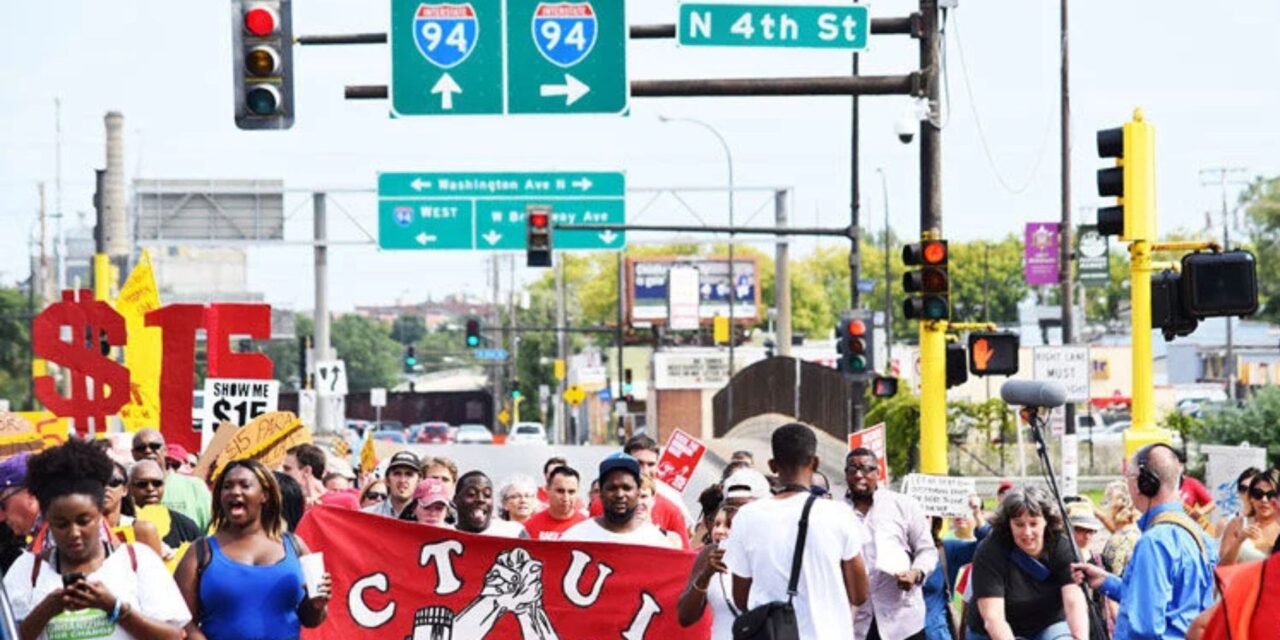
On Saturday (Sept. 10) West Broadway Avenue was closed to traffic for the celebratory festival, Open Streets … Monday (Sept. 12) a section closed to traffic for a different reason.
Protesters, including striking Alina nurses, took to the streets of West Broadway near Interstate 94 to rally and march in a show of unity and a renewed demand that Minneapolis adopt a $15 per hour living wage ordinance. This after the Minnesota Supreme Court ruled that the question that was set to appear on the Nov. 8 ballot did not conform to state law. Despite the court’s ruling, protesters are keeping the pressure on, hoping the city will enact a $15 per hour standard for those doing business within Minneapolis city limits. Organizers said Monday’s march and rally was a signal to the Minneapolis City Council and Mayor Betsy Hodges that they, nor the issue, would go away quietly.
“We’re not going to back down until Minneapolis approves a $15 per hour ordinance,” said Michael McDowell, one of the protest organizers. “They want us to wait, but the rent won’t wait. We need this now because we can’t wait. We can’t wait anymore. You’ve got CEOs making $9,000 an hour and us workers are out here making crumbs.”
For Alexis Collins, a worker at a Burger King in Fridley, she said her take-home pay of $237.50 per week is keeping her from even getting a place of her own to rent.
“I can’t get approved for an apartment and the government says I make too much for food stamps and I’m about to have my first child,” said Collins, 19. “I’ve been working at Burger King since I was 14 and this is all I get. It’s hard. It’s just not right.”
While Collins said she does not qualify for public assistance, Rosheeda Credit said raising her salary from $11 per hour as a personal care attendant (PCA) to $15 per hour would get her off of public assistance.
“For us to work all day, every day just to pay rent; it’s wrong,” said Credit.
Charles Thornton agrees that it is not right. Thornton, who works at the Wendy’s at 421 W. Broadway where protesters gathered, said not only are his wages keeping him mired in poverty, he is being denied benefits as well.
“I make $9.75 (per hour) and on top of that they keep me under 40 hours a week so they don’t have to offer me benefits,” said Thornton, who said he averages 36 hours per week. “I’m a faithful employee. I’m here every day. I’ve been here for seven years.”
The Rev. Paul Slack, president of ISAIAH, a faith-based coalition of more than 100 member congregations, said low wage workers are caught in a vicious cycle of poverty and debt; a cycle he likened to modern-day slavery.
“When workers are paid a poverty wage they can’t have an emergency, so when they do have emergencies like medical bills, a car in need of repair, they end up at places that are predatory lenders charging an average of 300 percent interest, getting further in debt, further behind and unable to even afford the basics,” said Slack. “We need a living wage. We need $15 now so that workers and families don’t end up in a cycle of debt; this modern-day slavery.”