When the opening chords faded on Radio KFAI 90.3 FM in Minneapolis, host Al McFarlane leaned into the microphone and said, “I’m Al McFarlane. Welcome to The Conversation with Al McFarlane. Today we’re talking all things Jamaica.” His tone carried both heaviness and urgency. A historic storm had just battered the island of Jamaica, and the Twin Cities’ Jamaican-diaspora community was mobilising to respond.
According to multiple international reports, Hurricane Melissa made landfall in Jamaica on 28 October 2025 as a powerful Category 5 storm with sustained winds of about 185 mph (circa 295 km/h). According to reports by several media outlets, the storm is now described as the strongest to ever strike Jamaica since systematic records began in 1851.
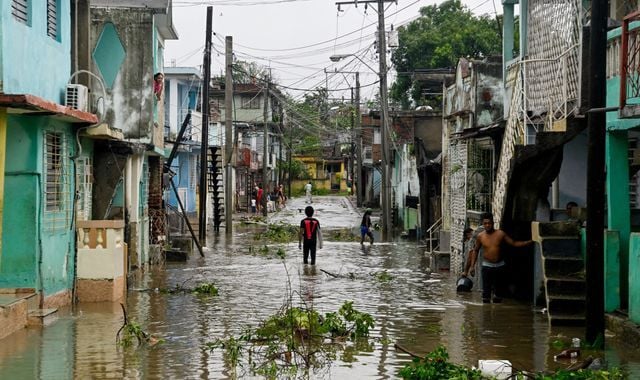
These outlets also reveal that the devastation has been widespread with hospitals damaged, entire communities cut off, major agricultural zones flattened, and power knocked out to hundreds of thousands. Reuters reports that the island’s southern and western parishes, St. Elizabeth, Westmoreland, St. James, Hanover, Trelawny were among the hardest hit. The scale of damage is still emerging, but one fact is clear: this is not business-as-usual. Jamaica is facing a disaster of extraordinary magnitude.
McFarlane introduced his cousin, Philip McFarlane, recording producer who owns Irejute Records and leads the roots band, EarthCry.He joined from Kingston via video livestream. “Me personally, I’m good,” Philip began. “But collectively, as a country, we’re going through it. Those of us who are in a better position to help, that’s what we’re doing.” He described the storm’s trajectory: “It came from the east, passed south, then went west and north-west. That took the eye through St Elizabeth, Westmoreland, St James, Hanover, Trelawny, Manchester, Clarendon. Even in St Mary, where I’m from: every farm tree down, houses without roofs. My mother’s roof is gone completely.”
He went on: “Some towns are marooned off. No electricity. No phones. No nothing. I read a story yesterday where somebody said they counted nineteen bodies on the ground, and they can’t access them.” His voice held the weight of that reality.
When asked where people are sleeping at night, he responded: “Outside. Thousands. It’s impossible for government or any institution to rebuild houses that quick. Some say bussing them to Kingston, tents, warm food, beds, but you’re talking about thousands of families in rural hills with no power, no roads. They are sleeping outside, catching on something.”
Philip then described how his group is already acting. “Last Thursday we brought food and fed fifty families with care packages. On Saturday we assessed damages. We have raised over a million dollars so far. Tomorrow we’re going to the hardware; we’ve got a truck ready. We’ll bring materials, start rebuilding roofs, the most damaged houses, many with small children.”
Joining from Minneapolis, Merina Neal, better known as Trinny Cee, a board member of the Caribbean Disaster Relief Fund of Minnesota, spoke with both heartbreak and determination. “It’s heart-wrenching,” she said. “I’ve travelled to Jamaica for twenty years, into communities like Flankers and Tivoli, not resorts. What I’m seeing now looks like a bomb went off. No green, just brown and broken. And yet, even in that, the people, while screaming for help, are not broken.”
Her organisation sprang into action within days. She explained: “We sent the email. We got together. We asked people to donate funds, to funnel money through official Jamaican government sites and through trusted local organisations. We put barrels at Galaxy Foods, at local Caribbean-community locations. We condensed the island’s long list of needs down to essentials: soap, toothpaste, batteries, tarps, blankets. New items only, please, not used clothing, so the message being sent to Jamaica is one of dignity.”
Trinny Cee has co-ordinated volunteers, social-media campaigns and local drop-off spots. “Galaxy Foods donated storage space, barrels and manpower. Tomorrow, we inventory, rebuild the barrels, and ship. Jamaica will need help for a long time to come, not a one-time thing.”
Philip, pausing only briefly, shared what struck him most in his visit to affected areas. “You can spend forty years chasing one thing: a house, car, and lose it in a day,” he said. “These people find happiness in living simple. They’re smiling, because their value isn’t in material things. You’ll see someone say: ‘My house is gone, but give me some board, some nail. We’ll string it back up, cook the food, laugh, play music.’ You can’t defeat them mentally.”
Al McFarlane closed the segment with the phrase his cousin had shared: “We’re not dead, but we’re going to suffer.” He paused. “That honesty matters.”
From Minnesota to Jamaica, communities are forging a bridge of care. Faith and action meet: one roof, one barrel, one family at a time. The storm may have left devastation in its wake, but the response is already moving forward.
World Central Kitchen reports it is grateful to receive incredible amounts of support and outreach to food crises in different parts of the world. People can join and support their efforts by visiting the following links.
#ChefsForJamaica
Donations made at donate.wck.org/give/738350/#!/donation/checkout will help support our efforts in Jamaica in response to Category 5 Hurricane Melissa.
#ChefsForHaiti
Donations made at donate.wck.org/give/692209/#!/donation/checkout will help support our efforts in Haiti in response to violence the region.
#ChefsForFeds
Donations made at donate.wck.org/chefs-for-feds-25 will help support our efforts supporting federal workers and their families during the ongoing U.S. government shutdown.
Volunteers: All open opportunities are listed at wck.org/volunteer and are updated whenever new needs arise.
Cookbook: After years of cooking alongside incredible heroes and serving more than 400 million meals around the world, WCK’s first ever cookbook is available at wck.org/cookbook-order. A special collection of stories and recipes from renowned chefs, local cooks, WCK friends, and Chef José Andrés, The World Central Kitchen Cookbook: Feeding Humanity, Feeding Hope is a celebration of dignity, perseverance—and above all, hope. All author proceeds will support WCK.
We Feed People: The Ron Howard-directed documentary about Chef José Andrés and World Central Kitchen premiered on Disney+ on May 27, 2022 . Visit wck.org/wefeedpeople to learn more.
Donations: To donate online by credit card, please visit donate.wck.org. You may also donate using PayPal. If you would prefer to send a check or cash, please make it payable to “World Central Kitchen, Inc” and mail to:
World Central Kitchen
PO Box 96538
Washington, DC 20090-6538, USA
PROGRESS. Today we went to bought the first set of materials to start rebuilding and fixing some of the homes of families affected by hurricane melissa in Western St. Mary.
Friday we will sort out and distribute accordingly.
Within a week I think we will have these folks covered properly and back in comfort of some sort. Big thanks to everyone who has donated to this cause. The people appreciate this so much. You all are help changing world. We will also distribute more food packages this weekend.
Feel free to donate with the link in my bio or visit https://gofund.me/376186c8d . Or DM for For other ways to donate.