In the weeks after protests against federal immigration enforcement spread through parts of Minneapolis, local and national Black leaders gathered in the city for an Emergency Black Leadership Summit, a meeting shaped by rising concern over policing, civil rights, and the direction of federal power.
The summit followed a period of heightened tension in the Twin Cities, including demonstrations at retail stores and other public spaces calling for the removal of U.S. Immigration and Customs Enforcement from the city. That broader climate was reflected days earlier on Radio KFAI 90.3FM’s The Conversation with Al McFarlane, where host Al McFarlane framed Minneapolis as “ground zero” for a renewed national reckoning.
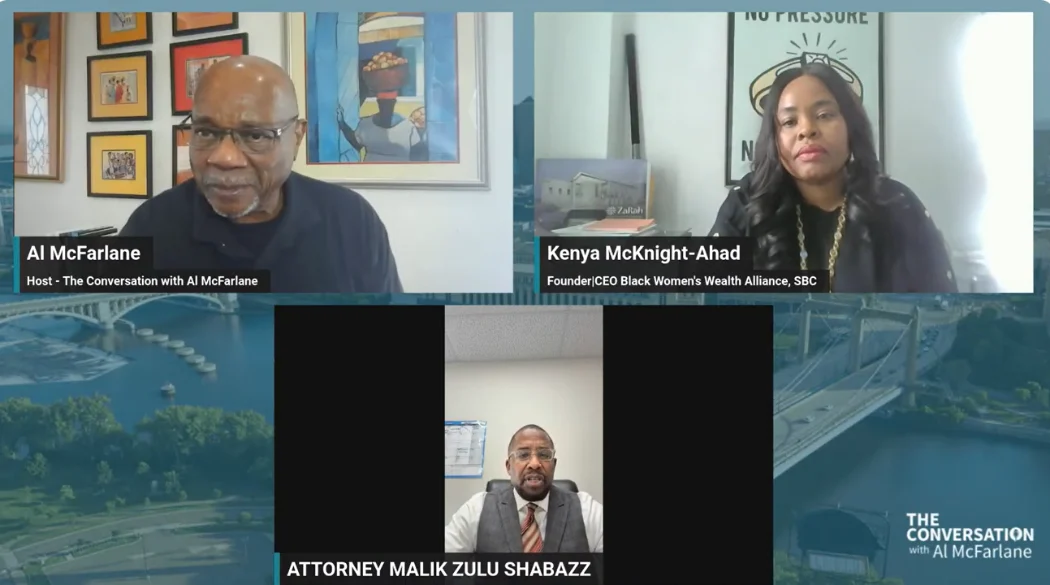
“We’re here in Minneapolis and Minneapolis I’m calling ground zero, the epicenter,” McFarlane said during the broadcast, recalling the lasting impact of George Floyd’s murder and describing George Floyd Square as “a sacred place because it shook the conscience of the community and awakened the conscience of the world.”
The program brought together Kenya McKnight Ahad, founder and CEO of the Black Women’s Wealth Alliance, and attorney Malik Zulu Shabazz, national president of Black Lawyers for Justice, to explain why organizers believed a coordinated response was necessary. Their conversation helped set the tone for the summit that followed.
“We’re here to say that that ICE problem is our problem too,” Shabazz said on air. “That police brutality is a problem for all Black people. And whatever form that it comes in, whether it’s coming from the Minneapolis police or if it’s coming from the National Guard or if it’s coming from ICE, that it’s a common problem that affects our people.”
When the summit convened, it focused on those same overlapping concerns: police brutality, legal rights, reparations, and what speakers described as the need for stronger unity across Black communities. Organizers also held legal trainings and strategy sessions, emphasizing practical tools alongside political analysis.
Shabazz had been clear that the gathering was not meant to be a single-issue response. “This is not just about ICE,” he said during the broadcast. “It deals with ICE, but we’re talking about our problems as a people. Police brutality, apathy, disunity. We’re calling for a Black United Front, an African united front so we can stand together.”
A central theme of both the radio discussion and the summit was whether immigration enforcement should be treated as separate from Black political struggles. Shabazz rejected that distinction. “As a Black person of African descent… any problem with Donald Trump and any police that comes from his direction is my problem,” he said. “If you are of African descent and you’re inside of these borders and you’re being assaulted or intimidated by this government, your problem is my problem.”
McKnight Ahad connected those arguments to everyday realities in Minneapolis, where, she said, Black communities were already feeling the effects of increased surveillance and enforcement. “We’re being detained. We’re being followed. They’re in our neighborhoods,” she said. “All sorts of things are happening right now that ain’t making it to the front scene. But believe it or not, Black folks are affected.”
She also warned against political disengagement. “If we’re not here talking about what’s important… then we’re going to kick back and be like, ‘Yeah, let them fight.’ By the time that gets done, we going to be almost wiped out,” she said.
The discussion on The Conversation also moved into history and risk, with McFarlane pointing to past moments when the U.S. government had stripped entire communities of rights. Shabazz responded bluntly, saying he could imagine “suspension of the Constitution” and “forms of martial law,” and arguing that Black communities could not assume they were insulated from future crackdowns.
Despite the severity of the warnings, both speakers emphasized action over fear. “Whether we live or die… we should not face it without a fight,” Shabazz said. “What we need is broadcasters of courage, lawyers of courage, activists of courage.”
By the time the summit concluded, organizers described it as a first step toward rebuilding coordinated leadership and long-term strategy in the city and beyond. McKnight Ahad summed up the moment as larger than any single policy fight. “This ain’t just about ICE,” she said during the broadcast. “You need to be focused on the Black agenda, the Black stability, the Black future.”
McFarlane closed the program with a phrase that captured the mood of both the conversation and the gathering that followed: “No pressure, no diamonds. It’s screaming time right now.”
The Emergency Black Leadership Summit was held in Minneapolis, Minnesota, on February 7–8, bringing together local and national leaders around issues including police brutality, Black unity, reparations, and self-determination.