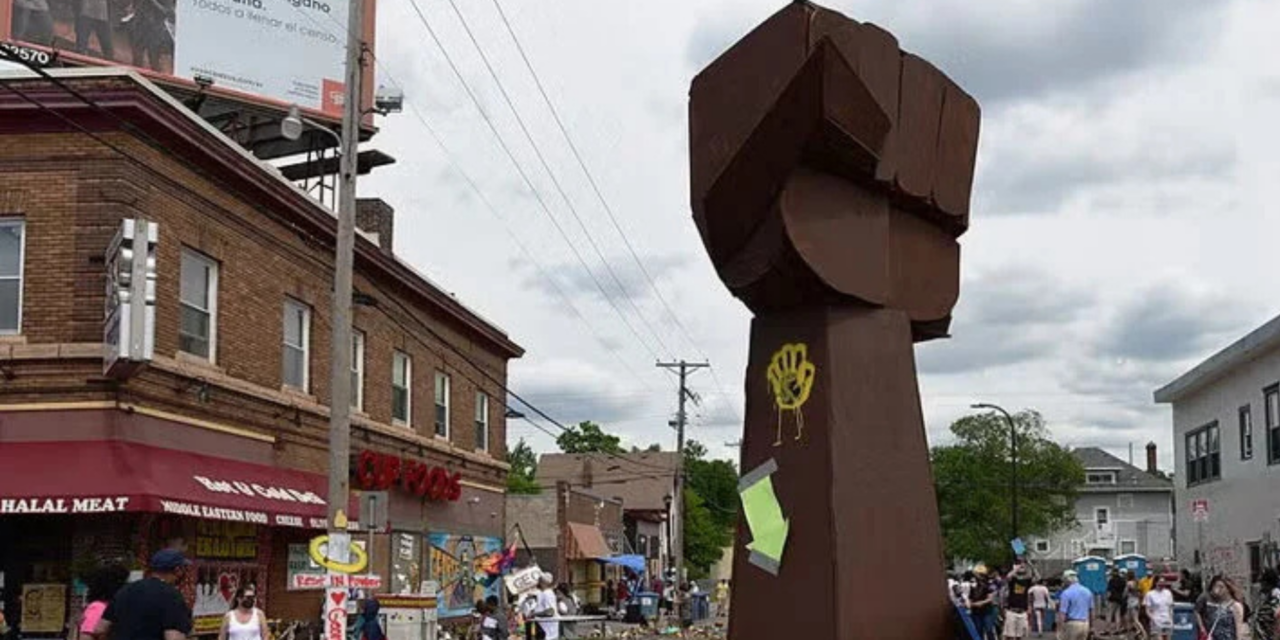
Six years after George Floyd’s murder pushed Minneapolis into the center of a global reckoning, community leaders gathered at George Floyd Square with a message that was both memorial and mandate: remember, organize and build.
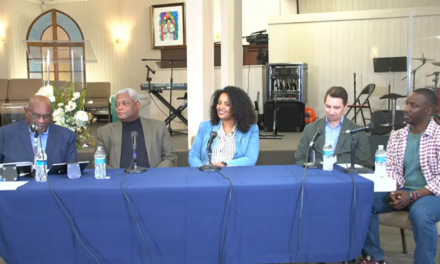
The conversation took place on Radio KFAI 90.3FM’s popular public affairs show The Conversation With Al McFarlane, which features discussions with community leaders about issues affecting the Black community and the broader public. Broadcasting live from Worldwide Outreach for Christ Church at 3808 Chicago Avenue South, near the corner where Floyd was killed, host Al McFarlane opened the station’s “Amplified Voices” series by calling 38th and Chicago “sacred ground, sacred space.”
The broadcast came as Minneapolis prepares for major reconstruction at George Floyd Square. The city says 38th Street and Chicago Avenue will close to traffic on June 8, 2026, and remain closed through late 2027 as part of the 38th & Chicago Re-envisioned project.
“We’ll be doing shows that commemorate where we are,” McFarlane said. “This is sacred ground, sacred space, 38th and Chicago, George Floyd Square. Legislative systems are moving forward to look at how this community is going to recover, revive itself from the trauma.” McFarlane said the week’s programming was intended to lift up people who were “witness and victims, but also victors,” describing them as community members who reveal “the resiliency of spirit and of heart” and remain committed to “building a future in which the best of us emerges.”
His first guest, Marquita Stephens, president and CEO of the Urban League of the Twin Cities, said time has not softened the pain of Floyd’s murder. “It is, those six years later, still a fresh memory,” Stephens said. “It was an impactful incident that occurred here, far-reaching, worldwide and not easily forgotten. The hurt of the murder of George Floyd lingers.”
Asked what she remembered from first hearing about Floyd’s killing, Stephens said she was shocked that the death had been captured on camera, but also grateful for the young woman who recorded it. “My first thought was aghast, certainly, that this could be caught on tape like it was,” Stephens said. “But I was really grateful that the young lady who filmed it was calm, and that she could stand in her space and actually record it for the length of time it occurred. Had it not been for her, we would not have had the opportunity to witness and to share that witness throughout the world in the same way that we did.”
For Stephens, the video did not allow viewers to remain detached. “She brought you into the moment when you’re watching it,” Stephens said. “So you might have a fresh reaction: get off of him, as though you were there in the crowd. I wondered if I might have been one of those people who tried to approach it, to try to intervene, because it just seemed to be that unfair. You couldn’t watch it without feeling a sense of unfairness, a sense of wrong, a sense of having gone too far.”
The discussion quickly turned to policing and accountability. McFarlane asked what the killing revealed about law enforcement and Black communities in Minneapolis. Stephens said it exposed a failure inside the police system itself.
“It pointed to a lack of checks and balances, internal checks and balances,” Stephens said. “This was not Chauvin’s first rodeo. Apparently, there was no process for checking his behavior. This was not his first time doing improper policing. And it called into question the ability internally of the police department, the police mechanism, to be able to check its own.”
That question remains current in Minneapolis. The city approved a federal consent decree with the U.S. Department of Justice in January 2025, but the Justice Department later moved away from the agreement. Minneapolis says a federal judge dismissed the proposed federal consent decree in May 2025, after which Mayor Jacob Frey signed an executive order committing the city to implement reforms from the proposed decree that are not already included in or in conflict with the state settlement agreement.
McFarlane placed Floyd’s death inside a longer history of violence against Black people in America. “This is something that we, as African people, as Black people, have seen again and again and again,” he said. “Our history in this country, in fact, is a history of watching ourselves be lynched, beaten, destroyed; families, communities, relationships, children, parents, wives, husbands. We’ve been through this. And it’s not a figment of our imagination. It’s the history.”
Stephens said the video gave younger generations a contemporary view of what many had only read about.
“It was an opportunity for every generation to be able to see what perhaps most of the living generations now have only read in books,” she said. “Particularly if you were born and socialized in northern cities throughout the country, it gave you an opportunity to really witness and to feel how these matters were handled in earlier African-American history in the United States.”
Kenya McKnight Ahad, founder and CEO of the Black Women’s Wealth Alliance, joined the conversation as McFarlane turned to intergenerational leadership. She said she was conducting a staff training on Emerson and Broadway when one of her team members began crying.
“She said, ‘You didn’t see the news?’ I was like, ‘No.’ And she said, ‘I’m not able to work,’” McKnight Ahad recalled. “She explained what happened, and so we all took a step back. None of us finished work. We were just there with each other.”
At first, she said, the news landed inside a familiar numbness. “When you interface with so much death, I didn’t get initially that it was something different,” she said. “I was just like, ‘Oh, the police killed somebody else again.’ There’s some kind of numbness that was there, that was just like, ‘Oh, this is what be happening.’”
Then she saw the video. “When you start watching it, that felt different than just the police killed somebody,” McKnight Ahad said. “It went from the police killing somebody to, in my mind, a public lynching happened, which I hadn’t seen in my lifetime. I see this. It’s recorded. That’s how I felt. It was a public lynching.”
She said Floyd’s killing made her feel unsafe in Minnesota. “I felt eerie. I felt like, where are we?” she said. “We’re in the North. It’s not as many Black people up here. They outnumber us here in a different way than if we were in the South or even in the lower Midwest where I’m from. I felt like we were in some times that we hadn’t faced before, and that this was a snippet of what our ancestors had to face.”
McKnight Ahad connected Floyd’s death to other police killings in Minnesota, including Jamar Clark and Philando Castile. She rejected the idea that Black communities become indifferent to repeated violence. “We mourn. Of course, we care,” she said. “We all show up. We cry for them. We hurt for them. We are angry. But at the end of the day, everybody’s still got to take care of the things you’re responsible for. You have to keep moving on with your life. But it doesn’t mean that we’re not concerned.”
As the conversation shifted toward solutions, Stephens described the Urban League as a civil rights and advocacy organization that has served the Twin Cities for 92 years through workforce, family stabilization and education programs. “Our mission is that through services, advocacy and community mobilization, we advance the social, political and economic success of African-Americans in the Twin Cities,” Stephens said. “We live up to that each and every day.”
McKnight Ahad said her work is rooted in Black women’s economic power. “In my world, a nation rises no higher than its woman, and the conditions of Black women will always dictate the conditions of the Black nation,” she said. “It’s to our benefit to make sure that she’s good. She’s stable, because if she is, then our nation is.”
The conversation also touched on DEI rollbacks, voting rights and economic pressure on Black-led organizations. McKnight Ahad pointed to Louisiana, where Republicans approved a new congressional map eliminating a Democratic-held majority-Black district, as a warning that communities must organize for themselves.
Back in Minnesota, McFarlane raised the fallout from the Feeding Our Future scandal. In May 2026, federal officials said Aimee Bock was sentenced to 500 months in prison for leading a $250 million fraud scheme involving federal child nutrition money. Stephens said legitimate community organizations are feeling the consequences.
“We’re seeing our contracts, invoices being held up for months,” Stephens said. “The impact is real on our agencies.”
Near the end, McFarlane asked each guest for one truth or call to action six years after Floyd’s murder.
Stephens answered simply: “Stand together.”
McKnight Ahad added: “Keep building. We have beautiful things that the community has built post George Floyd right here in this neighborhood, but also outside. Let’s keep building, keep fighting, keep going, keep moving together.”
At George Floyd Square, the message was clear: remembrance is not only about what happened in 2020. It is about what Minneapolis chooses to do next.