This may strike some of you as bizarre or maybe even a tad macabre, but every now and again, when I contemplate someone’s recent death, I wonder what the decedent was thinking (or how they were feeling) during their final moments before slipping into eternity…
This habit of mine surely includes historical figures, such as my recent first time watch of President John F. Kennedy’s final speech—given on November 22, 1963—in Fort Worth, Texas. I sat totally captivated by the charisma and charm on display by our nation’s 39th President during that high noon address to the Fort Worth Chamber of Commerce, and I could not help but feel eerily ill at ease in knowing that he didn’t have even the slightest clue that within an hour or so of that speech, that his life would be taken by assassins’ bullets in the Dealey Plaza in neighboring Dallas.
Much of President Kennedy’s struggles in Texas and across the Deep South stemmed from the fact that he had deliberately chosen to engage the Civil Right Movement, in general, and maintained seemingly warm public relations with several of its most popular leaders, including the Southern Christian Leadership Conference’s Dr. Martin Luther King, and the NAACP’s Medgar Evers, the latter of whom was killed by an assassin’s bullet in June of 1963—only five months before Kennedy met his own tragic fate.
As 1963 turned into ‘64, Kennedy’s successor, President Lyndon B. Johnson, set about the business of ensuring that the Civil Rights Act, one that would reverse nearly a century’s worth of Jim Crow segregation, was passed. While Johnson’s signing of that Act was a monumental achievement, the issue of Black voting rights remained problematic in the Deep South.
To that end, the Congress of Racial Equality (CORE) was among the vanguard of civil rights organizations mobilizing young men and women of diverse racial backgrounds to travel throughout the South in order to register Black voters in areas in which local laws, customs, and Ku Klux Klan intimidation had prevented them from voting since the late 19th Century.
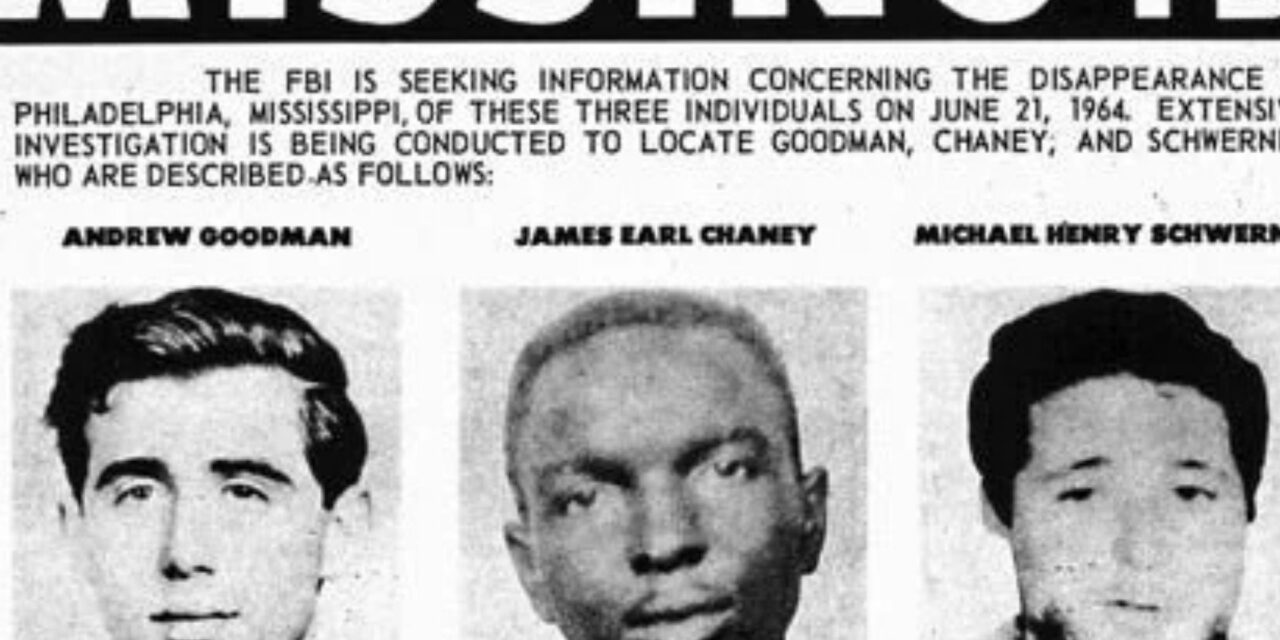
60 years ago today, three CORE workers, James Chaney, Andrew Goodman and Michael Schwerner, arose and began preparing to spend the day educating and registering potential Black voters in Neshoba County, Mississippi. The trio had no way in knowing that as they dressed, ate breakfast, and set out to handle their critically important business that the day would be their very last full day on Earth.
Chaney, a 21-year old Black Mississippi native, met New York natives Goodman (age 20) and Schwerner (age 24), during a CORE training session in Ohio; the trio were then assigned to Northern Mississippi in June of ‘64 to lead voter registration efforts.
On or about May 25, 1964, Chaney and Schwerner spoke to the congregation at the Black Mount Zion United Methodist Church in Longdale, Mississippi about setting up a Freedom School and organizing a voter registration drive at the church. When the Ku Klux Klan got word, they harassed and beat church members the following week—and then set the church building on fire.
Several weeks later, on or about June 21st, Chaney, Schwerner, and Goodman drove to inspect the burned ruins of Mount Zion, and as they drove away in a station wagon, Chaney, the driver, was stopped by local law enforcement and arrested for speeding—while Goodman and Schwerner were held at the Neshoba County Jail for “investigation.”
When fellow civil rights workers became worried after the trio did not check in on the evening of the 21st, they called the county jail to inquire as to whether they were being held. The jail’s clerk, upon orders of Sheriff Lee Rainey and Deputy Sheriff Cecil Price, denied that they were in custody.
In the meantime, Rainey and Price, both members of the Ku Klux Klan and the equally racist White Citizens’ Council, informed their fellow Klansmen that they had captured the two “Northern Agitators” and one “uppity N-word” who had stirred up talk of Black voting in Neshoba County. Later that evening, the three young civil rights workers were beaten and then shot multiple times by the Klansmen and buried on a farm several miles south of town.
Within weeks, the Federal Bureau of Investigation descended upon Mississippi to find the bodies; of worthy mention is the fact that United States Navy divers, unable to locate the missing civil rights workers in nearby lakes and swamps, discovered seven (7) other bodies of missing Blacks in the process!
On or about August 4, 1964, following a tip, the FBI located Chaney, Goodman, and Schwerner’s decomposing bodies in a shallow grave in a nearby Earthen dam.
As was typical in this era, the local district attorney was unwilling to charge the white defendants with murdering a Black man or his white allies; contributing to this reticence were observations by FBI informants that local law enforcement served as a valuable resource to the Klan by providing information like car license plate numbers and reports of prominent civil rights leaders flying in and out of the state.
Nevertheless, U.S. Attorney John Doar indicted several under federal civil rights charges and in 1967, the following were convicted: Deputy Sheriff Price, Klan Imperial Wizard Samuel Bowers, Alton Wayne Roberts, Jimmy Snowden, Billey Wayne Posey, Horace Barnett, and Jimmy Arledge. None of the convicts served longer that six years for their murderous acts.
Among the acquitted included Sheriff Rainey and Edgar Ray Killens, a preacher and architect of the lynching who one juror refused to convict “because he was a minister.” In a bit of delayed justice, in 2005, “Reverend” Killens, then 80 years old, was finally convicted of manslaughter and was sentenced to 3 consecutive 20 year sentences. Killens died in a Mississippi State Penitentiary at the age of 92.
As for the legacy of Chaney, Goodman and Schwerner, one year after they were murdered, President Lyndon Johnson signed the Voting Rights Act into law, one that provided Blacks—at least on paper—the full enforcement of the 15th Amendment that was ratified way back in 1870, but seldom enforced until the 1960’s.
Lest we forget…
Subscribe to Hobbservation Point
Chuck Hobbs is a freelance journalist who won the 2010 Florida Bar Media Award and has been twice nominated for the Pulitzer Prize for Commentary.
"Real Politics in Real Time"
Chuck Hobbs is a freelance journalist who won the 2010 Florida Bar Media Award and has been twice nominated for the Pulitzer Prize for Commentary.