
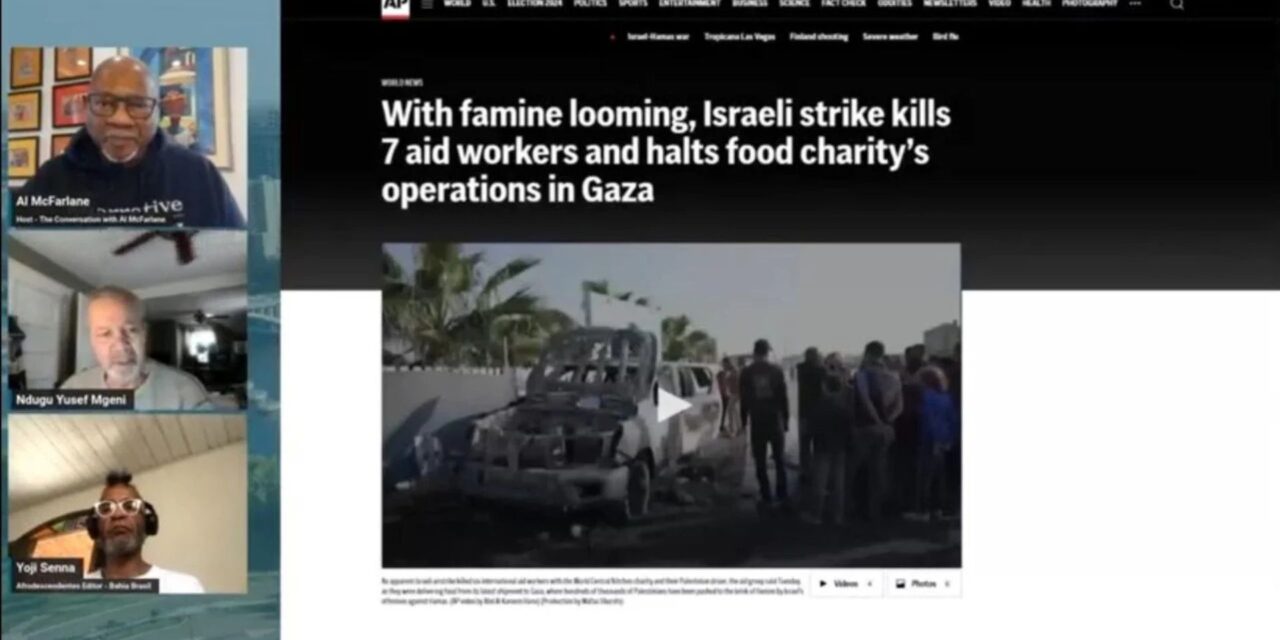
As the Israel-Hamas conflict rages on, a stark reality emerges from the rubble: the true cost of war measured not in territory gained or lost, but in lives shattered and futures extinguished. In a candid conversation hosted by Al McFarlane, joined by Yusef Mgeni and Yoji Senna, the devastating toll of the conflict comes to the forefront, prompting a sobering reflection on the humanitarian crisis unfolding in the heart of the Middle East.
McFarlane sets the tone for the discussion, urging listeners to bear witness to the unfolding tragedy. “It’s a war that extends far beyond the battlegrounds,” he observes, inviting his co-hosts and listeners alike to confront the harsh realities faced by those caught in the crossfire.
Mgeni, drawing attention to recent events, recounts the harrowing fate of seven aid workers from the World Christian Association, whose mission of mercy ended in unspeakable tragedy. “They were delivering 100 metric tons of humanitarian food aid to people in Gaza,” he explains, “only to be met with devastation at the hands of the Israeli Defense Force.” The incident serves as a chilling reminder of the indiscriminate nature of the conflict, where even those striving to alleviate suffering are not spared from its wrath.
As the conversation deepens, Senna offers a perspective from Brazil, highlighting the global resonance of the conflict. “For the average Brazilian, there’s a distance to that reality,” he acknowledges, “but the injustice and atrocity being committed demand our attention and condemnation.” His words echo the sentiments of millions around the world, grappling with the moral implications of a conflict that knows no borders.
The discussion turns towards the geopolitical dimensions of the conflict, with Mgeni sounding a note of caution about the potential for further escalation. “Iran has been identified as supporting the people in opposition to the current treatment of Palestinians in Israel,” he notes, highlighting the complex web of alliances and animosities shaping the region’s destiny. The specter of a wider war looms large, casting a shadow of uncertainty over an already volatile landscape.
Amidst the geopolitical maneuvering, Netanyahu emerges as a central figure, his actions scrutinized for their impact on the trajectory of the conflict. Senna offers a damning indictment of the Israeli Prime Minister, accusing him of using the conflict as a smokescreen to evade legal consequences. “He’s trying to divert attention to avoid jail time,” Senna asserts, drawing parallels between Netanyahu and other embattled leaders facing legal scrutiny.
As the conversation nears its conclusion, the hosts reflect on the human toll of the conflict, underscoring the urgent need for humanitarian intervention. “Under the current conditions, they’re predicting that 50% of the people in Gaza will starve before long,” Mgeni reveals, painting a grim picture of the unfolding crisis.
In the face of unimaginable suffering, the conversation ends not with despair, but with a glimmer of hope—a belief that through collective action and unwavering resolve, peace is possible.