This conversation took place prior to last week’s election, as community leaders and activists prepared for an outcome that could reshape Minnesota’s future. At the time of discussion, Al McFarlane and his guests were eagerly awaiting election’s results, hopeful that their efforts would foster a strong voter turnout and propel meaningful change. Their words capture the anticipation and stakes felt by many leading up to the final count. The discussion reflects pre-election perspectives, with participants rallying the community to exercise their voting power for equitable representation. The panelists’ messages were deeply rooted in their commitment to civic engagement, regardless of the final outcome. As results come in today, these voices offer a reminder of the importance of persistent advocacy and the power of each vote cast.
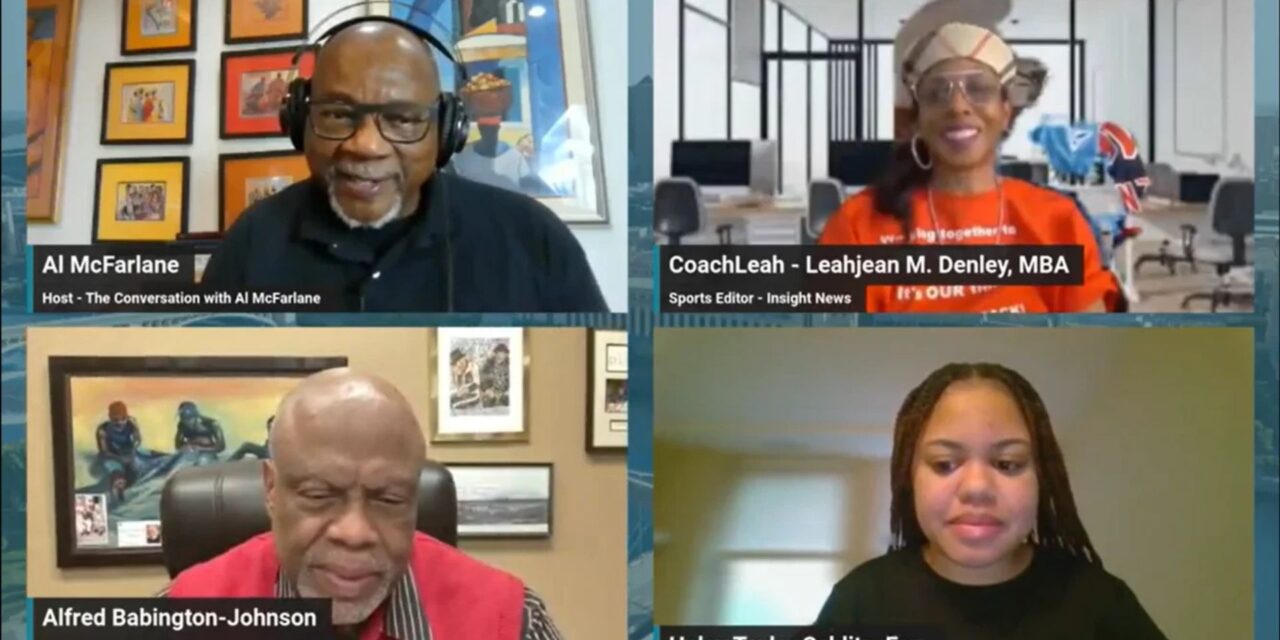
On election day, KFAI’s The Conversation with Al McFarlane gathered community leaders and changemakers for a powerful discussion on pressing issues—from civic engagement to the state of education and the impact of media and celebrity. Host Al McFarlane opened the conversation with a call for community involvement, underscoring that voting is both a right and a responsibility. As McFarlane introduced Alfred Babington-Johnson, a civil rights veteran and founder of His Works United. Johnson traced his roots in activism back to the 1950s and 60s, expressing deep concern about today’s fragmented social landscape. “I’m a child of the civil rights era,” he shared. “I think our community lost sight of what the prize was—equal resources and real equity.” His reflection on the struggles of the past laid the groundwork for discussing ongoing challenges facing the Black community, including the rise of white Christian nationalism.
McFarlane pivoted to the influence of religion on politics, specifically calling out recent remarks by Pastor Donnie Swaggart, who criticized Black church leaders supporting Vice President Kamala Harris. “So said the man whose fathers enslaved mine,” McFarlane remarked, encapsulating the anger and frustration felt by many. Johnson echoed these sentiments, condemning the manipulation of faith to maintain power structures. “We see a form of privilege disguised as principle,” he asserted, prompting listeners to consider the intersections of faith, politics, and justice.
The conversation shifted naturally to education, with attorney Haley Taylor Schlitz, who, at 22, is the youngest Black woman to earn a law degree in the U.S., offering insights. Reflecting on her own experiences in Texas, Schlitz noted how the education system fails students of color. “We’re missing the cultural foundation that grounds students in truth and equity,” she argued, describing a system that often glosses over Black history and civic values. Schlitz’s words highlighted the need for cultural representation in curricula and reinforced Johnson’s belief in the importance of community-driven education. “The struggle continues,” he stated, warning that “if you slack, you fall back.” Schlitz expanded on the importance of community engagement in education, stressing that parents, teachers, and organizations must work together to support Black and Brown students. “It’s not enough to just check students in and out each day,” she said, urging for deeper involvement to instill values and cultural pride.
Her comments set the stage for Jonathan Palmer, a community leader and former head of the Hallie Q. Brown Community Center, to speak on the evolution of media and its responsibility in educating the public. Palmer described the shift from traditional journalism to today’s media landscape, where opinion is often presented as fact. “We trusted journalists once, but now we have opinion posing as fact,” he said, emphasizing the need for critical engagement with information. Highlighting the significance of diverse media sources, he pointed out that international outlets often provide more objective perspectives on American politics than many domestic ones.
As the conversation flowed into a discussion on the influence of celebrities in politics, McFarlane brought up public figures like Taylor Swift, Beyoncé, and LeBron James, acknowledging their role in mobilizing public sentiment and pushing for social change. Johnson agreed, noting, “The power of these voices is undeniable.” He acknowledged that today’s influencers occupy a space where they can inspire real political action, transcending their industries to advocate for justice and equity.
McFarlane wrapped up the hour with an urgent reminder to listeners. “Today is the moment of decision,” he declared, leaving the audience with a rallying cry to exercise their rights and remain vigilant in the fight for a fairer, more inclusive society. The discussion on The Conversation with Al McFarlane underscored the intertwined nature of education, media, and political engagement, reminding Minnesota’s community of the ongoing work needed to build a future where everyone’s voice is heard and valued.