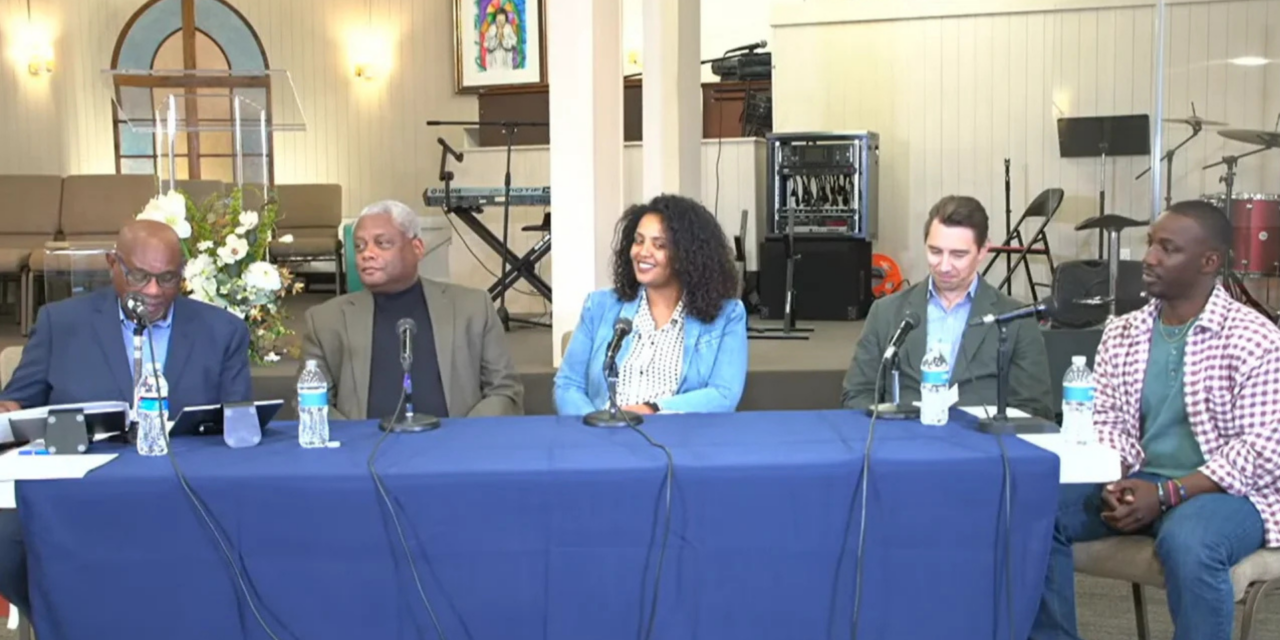
The fifth and final day of KFAI’s Amplified Voices, Global Impact series ended with a challenge: George Floyd’s murder moved the world, but global attention means little if it does not become power, policy, philanthropy, economic investment and organized political action.
“When the cameras left, the legacy of loving and being permanently committed to Black people would not,” said Lulete Mola, president and co-founder of the Black Collective Foundation Minnesota.
The conversation took place live from George Floyd Square on Radio KFAI 90.3FM’s The Conversation With Al McFarlane, a public affairs show centered on conversations with community leaders about issues affecting the Black community and the broader public. Broadcasting from Worldwide Outreach for Christ Ministries at 3808 Chicago Avenue South, host Al McFarlane said the final discussion would explore “global connections between justice, identity, economic empowerment, culture, and collective progress” across the African diaspora.
The broadcast came as Minneapolis prepares to close 38th Street and Chicago Avenue to traffic on June 8, 2026, for the 38th & Chicago Re-envisioned project, with construction expected to continue through late 2027. But Friday’s conversation looked beyond the physical future of the square. It asked what happens to a global racial justice movement when the world stops watching. McFarlane framed the hour around the need for communities to “reclaim our democracy” and organize ahead of November, saying “every moment between now and November is a moment for mobilizing.”
Kevin Lindsey, CEO of the Minnesota Humanities Center and former Minnesota Department of Human Rights commissioner, said Floyd’s murder immediately took him back to earlier cases, including Jamar Clark and Philando Castile. Lindsey said the video made him think both as a lawyer and as a Black man.
“My wheels were turning to think about how we might position community for success, how we might position success in the courtroom,” Lindsey said. “And just on a visceral level, being emotionally torn up because I knew what this would then mean for the community.”
He said the community’s insistence on accountability was central to the legal outcome.
“It was hard for folks to turn away, but it was very important for them to see it and communicate it and tell others,” Lindsey said, “because unless that happens, no measure of justice, and it was never complete justice given, but no measure of justice in the courtroom was ever going to be afforded unless we demanded it as a community.”
John Bartee, introduced as a Liberian-born community organizer active with the Minnesota DFL, said the case forced him to see Minnesota as a place where the unfinished work of civil rights remained urgent.
“Looking back at George Floyd and seeing the whole world looking at Minnesota, it was surreal,” Barti said. “You come to this country and, from an immigrant lens, you kind of think, all that stuff is in the past. But it brought back that Dr. King’s vision has not been fully realized.”
Barti said the global attention created responsibility, not distance.
“Now that we’re here in America and the world is watching us, we have to show that those of us who came here still are a part of this fight,” he said. “We cannot just be watching.”
That global lens was central to Mola’s remarks. The Black Collective Foundation Minnesota describes Mola as its president and co-founder and says the organization is Minnesota’s first Black community foundation. Mola said Floyd’s murder did not become a worldwide reckoning only because of the violence itself, but because of the community’s response to it.
“It’s not necessarily the actual murder of George Floyd, may he rest in peace, that ignited a worldwide awakening,” Mola said. “It is our community’s response to it, the fact that we came together and said we are intolerant of this racism and this anti-Blackness.”
She traced her own Black identity to being born in Addis Ababa, Ethiopia, and raised with an “abundant Black identity,” saying her mother would tell her, “You are as great as the Nile.” Coming to the United States, she said, meant confronting a country that told Black people they were “less than.”
That tension shaped how she entered philanthropy after Floyd’s murder.
“I was like, what is my proximity to power?” Mola said. At the time, she was working at the Women’s Foundation of Minnesota and knew “there were resources that flowed every day about us and did not include us at the table.” She said she called Chanda Smith Baker and Repa Mekha with a clear message: “Your sympathy is good, but we need real transformational change.” The group that emerged, she said, was first called the Philanthropic Collective to Combat Anti-Blackness and Realize Racial Justice.
“We weren’t playing games,” Mola said. “We were going to call a thing a thing.” Floyd’s death, she added, “was not this singular moment with this police officer. It was from the time he was born, and every single system that he touched needs to be addressed and transformed. And philanthropy has a big part in it.”
Peter Frosch, CEO of GREATER MSP, said Floyd’s murder changed how the region was seen internationally. GREATER MSP describes itself as the regional economic development partnership for Minneapolis-Saint Paul, with Frosch listed as CEO.
“When I’m abroad, I’m an American,” Frosch said. “There are a lot of questions about America in this moment.” He said people in cities including Tokyo, Sydney and Amsterdam connected Floyd’s story to injustices in their own countries.
For Frosch, the central question became “what comes next.” “Out of pain and tragedy and loss, there’s energy,” Frosch said. “What we see here is the motivation to create something new.” He said the region must move beyond “programs and initiatives and pilots” into “systems and institutions and policies” and “markets,” because that is where deeper change happens.
He pointed to the GroundBreak Coalition as one example. GroundBreak says its 2034 goals include 11,000 homeowners, 5,000 businesses and 60 new developments, while Minnesota Housing reported that the coalition announced nearly $1 billion in early commitments to expand wealth-building opportunities.
“This is something big,” Frosch said. “That’s the scale that we need.”
McFarlane also read from an Insight News article describing Floyd’s global impact, citing protests from Rio de Janeiro to Bristol, London, Colombia and Africa. Globally, Floyd’s death sparked demonstrations across more than 50 countries, according to The Guardian, while the United Nations said his death galvanized worldwide protests against racism and discrimination.
The hour closed with Al Flowers tying remembrance back to political organizing through the United Black Legislative Agenda.
“Thank you for keeping it going, keeping remembering, because they want to forget what happened to George Floyd,” Flowers said. “We got to keep it alive.”
For McFarlane, the final lesson of the week was that visibility is not enough.
“Lasting change requires more than moments of visibility,” he said. It requires “sustained connection, investment, leadership, and collective action.”