More Than a Fraction
By Kerri Moseley-Hobbs
When I was in my senior year of college, we had the honor of a guest speaker who talked about oral traditions, griots, and our ancestry. We hung onto his every word. That speaker was Alex Haley, the author of Roots. For us the Black students on campus, it was a revelation.
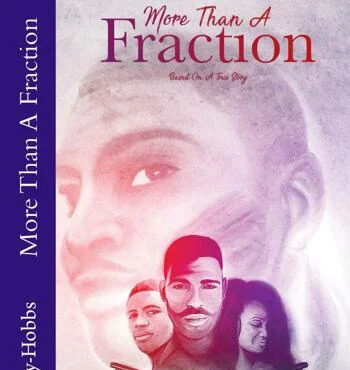
Fast forward to today. We have more methods to trace our ancestry, such as Ancestry.com and the archives of the historical societies in the states, plus family records. And of course, since African cultures are steeped in oral tradition, we also have the stories that have been passed down from generation to generation. In the spirit of the search for our ancestors, I bring you Kerri Mosely-Hobbs’ story, More Than a Fraction.
The saga begins in the early 19th century with Jack Fraction. His Yoruba name was Oyewole, which means “honor has come.” He had been brought over from Africa via the slave trade, and with him the traditions of his native tongue, the oral traditions of the tribe, and the ceremony of merriment. We learn about the lessons of survival Jack learns in this strange land, such as when the whites actively seek to suppress his use of his Yoruba language, one his son John only knows a few words of. Other oppressive means are used to enforce the sense of disenfranchisement. However, Jack’s inner strength and spirit cannot be broken, and he and his partner Fanny pass this down to their descendants.
As the years roll by into the Civil War and Reconstruction, much of the story centers around three of John Fraction’s children–Thomas, Othello, and Virginia. They eventually become soldiers in the Union army, with Thomas promoted to the rank of sergeant. Virginia gives us the perspective of the tightrope she walks while working on the Smithfield Plantation. The survival mode taught by Jack is there when it comes to whites, as evidenced by Thomas concealing his ability to read and write. Their former slaveowner, Robert Preston, represents the nemesis entrenched in the antebellum attitudes and racism familiar to so many Black people, yet there is that spine of steel and resilience in Thomas and his family that strives for a different fate for themselves and their children—one of freedom.
As the great-great-great-granddaughter of Thomas Fraction, Moseley-Hobbs gives an awesome testimony of where her family has been and the refusal to accept less than freedom, as shown in Thomas’ quiet but firm defiance of Robert Preston’s efforts to force him to return to Smithfield Plantation during Reconstruction. In addition, she illustrates the complex relationships between white slaveowners and Black slaves, and the dilemma of those slaves who had no real concept of what freedom was when the Civil War ended.
From photographs, military documents, state and federal documents, and the stories handed down through her family, Moseley-Hobbs’ story carries a powerful legacy—knowing where one has come from, where one is, and where one is going as an African American. I acknowledge her for making those connections that have bridged centuries.
More Than a Fraction is available through Amazon and Barnes and Noble. To the Fraction family here in Minnesota as well as Virginia and other parts of the U.S., I share with you this quote from Maya Angelou:
“Bringing the gifts that my ancestors gave
I am the dream and the hope of the slave
I rise
I rise
I rise.”

W.D. Foster-Graham
W.D. Foster-Graham is a native son of Minneapolis, Minnesota. He received a B.A. in psychology from Luther College, and he was an original member of the multi-Grammy-Award-winning ensemble, Sounds of Blackness. He has also been recognized by the International Society of Poets as one of its “Best New Poets of 2003,” is a guest writer for journalist/author/entertainer Wyatt O’Brian Evans.