“Until the lion tells his side of the story, the tale of the hunt will always glorify the hunter.”
–Luvvie Ajayi
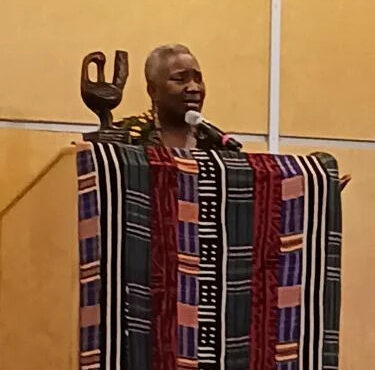
On November 12, I had the honor of being among kings and queens—the attendees of the Sankofa event at Macalester College, hosted by executive director Rekhet Si-Asar of In Black Ink. The keynote speaker was radio personality, journalist, and editor-in-chief of Insight News Al McFarlane, with respondents Dr. Danielle Brown, professor of journalism, diversity, and equality at the University of Minnesota, and multi-Emmy award winner and PBS executive producer Daniel Pierce Bergin.
With the musicians, singers, meals, and speakers, the afternoon was filled with the strength of community. What made this event so powerful is the fact it was a multigenerational event, given the topic—”Perilous Times: Defending and Defining the Spirit of Black Media.” Our speakers covered the history of the Black press and the pivotal role it has played then and now. McFarlane stated the purpose of the Black press in three I’s: inform, instruct, and inspire. Today, mainstream media still doesn’t cover the whole truth of the Black diaspora. It is crucial as people of African descent to define ourselves and stand in our truth, and then pay it forward to our children.
During the second portion of the event, the attendees broke out into groups, with facilitators from the area high schools and colleges. Sharing viewpoints from our diverse generations opened up the dialogue, and I learned more about the divisions that were artificially created between African American and African-born people. Themes discussed at my table were self-definition (we don’t need white validation of our parking ticket of Black excellence), utilizing the resources we have now about our culture to teach our children, and having the written tradition to go with our oral tradition, of which our elders are a vital component.
Being plugged in to Black authors, newspapers, and other media resonated with me. I remember an incident a few years ago, when I called a TV/radio station and asked if they reviewed books by Black authors. The man on the other end told me that Black authors were mainly self-published, and the books weren’t very good. The taste that left in my mouth reminded me of my experiences of Publishing While Black, and I refused to allow that attitude to stop me as an independent author. There is more work to do, and Saturday’s event only reinforced why I do what I do to support Black authors and poets in this column.
One of my former pastors once told me, “Bloom where you’re planted.” I’ve had the honor of reviewing books by amazing authors since I started writing my column, which contradicts the assumption that self-published books by Black authors “aren’t very good.” I also have empowering partnerships with organizations such as In Black Ink, Planting People Growing Justice, and the Minnesota Black Authors Expo. There is unity in our diversity, and we grow as a people as a result. An event is only as good as the energy we bring to it, and everyone at this Sankofa event brought their own special gift. You are kings and queens. Keep on owning it.
In the spirit of Sankofa, let us be intentional in our support of Black authors, Black newspapers/media, Black content creators, Black publishers, our younger generation, with our resources, our book reviews, our finances, and last but not least, our time.
Let the lion tell his side of the story.

W.D. Foster-Graham
W.D. Foster-Graham is a native son of Minneapolis, Minnesota. He received a B.A. in psychology from Luther College, and he was an original member of the multi-Grammy-Award-winning ensemble, Sounds of Blackness. He has also been recognized by the International Society of Poets as one of its “Best New Poets of 2003,” is a guest writer for journalist/author/entertainer Wyatt O’Brian Evans.