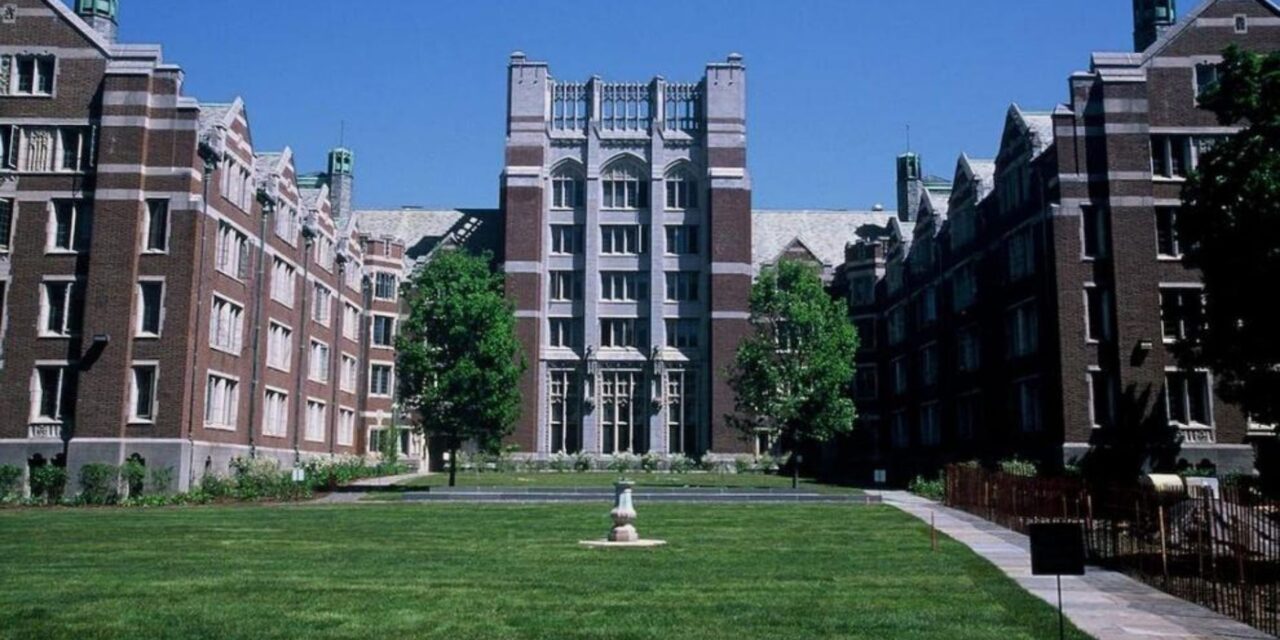
Yesterday, students at Wellesley College voted in favor of a non-binding resolution to allow transgender men and nonbinary people who were assigned male at birth to be eligible for admission.
As a result, a number of media observers immediately questioned whether the Wellesley vote, should it eventually morph into the school’s formal policy, would change the mission of the Massachusetts based school that has been one of the leading liberal arts colleges in America, one whose famous alumnae include former Democratic Presidential Nominee Hillary Clinton, and former Secretary of State Madeline Albright.
As I read articles about the Wellesley vote in both the New York Times and Washington Post early this morning, I could not help but wonder whether the move portends that by the end of the 21st Century, other traditionally single gender colleges in America, including Morehouse College, Spelman College, and Bennett College—three leading HBCU’s—will ostensibly become coed in theory (if not in actual practice)?
Well, as law students learn during the first day of law school, the first answer to that question is “it depends…”
Delving deeper, prior to yesterday’s vote, the Wellesley administration outlined its current position in a letter that held as follows:
“What does Wellesley mean by “a women’s college”? In accordance with our admission policy, Wellesley admits applicants who identify and live consistently as women, regardless of the gender they were assigned at birth. Our community includes students from a broad spectrum of racial, ethnic, geographic, socioeconomic, and religious groups. We know that the experience of living and learning as part of a diverse student body leads to better educational outcomes and helps prepare students to be the leaders, changemakers, and citizens the world so desperately needs.”
Following the vote, the college issued another statement:
“Wellesley College acknowledges the result of the nonbinding student ballot initiative. Although there is no plan to revisit its mission as a women’s college or its admissions policy, the College will continue to engage all students, including transgender male and nonbinary students, in the important work of building an inclusive academic community where everyone feels they belong.”
Regarding inclusion, one of the primary issues at Wellesley and other traditionally single gender colleges is the use of feminine or masculine pronouns to describe the collective student population, and the feminine Latin “alumnae,” or masculine “alumnus,” to describe graduates regardless of how the same self-identity.
As a 1994 graduate of Morehouse College, I must admit that in the nearly 30 years since my undergraduate school days ended, that I am somewhat amazed by the policy changes at the very Baptist affiliated institution that’s produced a “Who’s Who” in American history including theologians like Rev Dr. Martin Luther King, Rev. Dr. Howard Thurman, and Rev. Dr. Sen. Raphael Warnock (D-Ga), among many others.
Now, during my matriculation, there certainly were homosexual Brothers who, due to the customs at the time, were forced to keep their sexual orientation in the closet.
And lest we forget that just over a decade ago, Morehouse’s administration issued a policy that strictly forbade students from cross dressing or carrying purses and whatnot on campus in an effort to enforce uniformity over individuality in apparel.
As such, I was rather surprised when Morehouse announced in 2019 that it would begin admitting transgender students who identify as male regardless of the gender assigned at birth, because such would have been unfathomable just a generation ago. When the policy change was announced by Morehouse President David Thomas, my friend and Kappa Alpha Psi Fraternity Brother David Johns, the executive director of the National Black Justice Coalition (NBJC)—a Black LGBTQ civil rights organization—praised the school by saying, “Trans men are men, which is exactly why they should be supported in matriculating at Morehouse College.”
Now, Morehouse was not the first single gender HBCU to take the leap as Bennett College, an all-women’s college that was at the vanguard of the Civil Rights Movements in Greensboro, North Carolina during the 1960’s, changed its policy in 2017 to include:
“Bennett College admits self-identified women and people assigned female at birth who do not fit into the gender binary…Bennett College does not accept applications from men. Those assigned female at birth who identify as men are not eligible for admission.”
A year later, Spelman College, a women’s college located just across the way from Morehouse, changed its policy in 2018 as follows:
“Spelman College will consider for admission women students, including students who consistently live and self-identify as women, regardless of their gender assignment at birth …Spelman does not admit male students, including students who self-identify and live consistently as men, regardless of gender assignment at birth…Once admitted, any student who fulfills the College’s graduation requirements — regardless of gender identity, gender expression or sexual orientation — will be awarded a Spelman degree.”
While Morehouse, Spelman, and Bennett allow transgender students to enroll, each also states that during matriculation, should the admitted transgender student no longer identify with the dominant school gender and reverts back to the opposite gender assigned at birth, that such is a ground for exclusion from school; similar language is the norm at Wellesley and PWI single gender schools as well.
This last issue, coupled with the aforementioned pronoun usage issue, are not just the next steps in the battle for inclusion via self identification, but depending on the ultimate outcome in the decades ahead, could render single gender schools a nullity in the American educational tapestry.
Stay tuned…
Subscribe to Hobbservation Point
By Chuck Hobbs · Hundreds of paid subscribers
“Real Politics in Real Time”
Chuck Hobbs is a freelance journalist who won the 2010 Florida Bar Media Award and has been twice nominated for the Pulitzer Prize for Commentary.
"Real Politics in Real Time"
Chuck Hobbs is a freelance journalist who won the 2010 Florida Bar Media Award and has been twice nominated for the Pulitzer Prize for Commentary.