
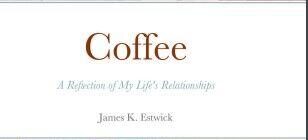
COFFEE
A Reflection of My Life’s Relationships
By James Estwick
There is a certain power about Spoken Word. Spoken Word can be whimsical, lighthearted, introspective, angry, vibrant, poignant, heartwarming, heartbreaking, loving, inspirational…yet overall, Spoken Word is deeply personal. Some, like myself, have to be in a certain mental space to write poetry; others do so easily, with grace and panache. Although people draw different experiences from it, no one can do Spoken Word like the poet. That being said, I bring to you James Estwick’s Coffee: A Reflection of My Life’s Relationships.
Estwick’s collection came from the poems he wanted to share as an exhibit in an art show, the theme being “Connections.” For him this meant relationships. Like many of us authors/poets, he had his concerns about putting himself out there. To do so meant being vulnerable, stepping out of his comfort zone. Once we do that, however, it empowers us and our passion.
Featured in his collection are the following: “Coffee,” “Suicide,” “A Letter to My Younger Self,” “Watch the World Burn,” “Rivers,” and “Bloom.” Estwick is intentional in the placement of each piece, designed to bring them full circle.
In “Coffee,” we see a relationship with his grandfather; the vivid memories of him, the questions never asked, what is held in the heart when someone significant in our lives is gone.
“Suicide” deals with self-worth, isolation, and the toll that hiding one’s authentic self out of fear takes on a person’s ability to love one’s self.
When I read “A Letter to My Younger Self,” I thought of the It Gets Better Project. Everyone reading it will have a different experience of it; for me, as a same-gender-loving man of a certain age, I could have written that letter to my 17-year-old self.
“Watch the World Burn” is so relevant to the events of today when everything seems to be falling apart, and yet there is hope.
The connections of past and present in “Rivers” have a bittersweet flavor when it comes to history as African Americans have lived it, the legacy that is with us today.
In “Bloom,” the sadness comes through about an unfortunate reality, where the memories of George Floyd, Breonna Taylor, Philandro Castile, and how they died are represented collectively front and center.
As I mentioned earlier, each reader will come away with something different in Estwick’s collection, and I appreciate his creativity and the vulnerability in his work. I could almost see the exhibit as I read.
Coffee is available on Amazon and the Minnesota Black Authors Expo website, www.mnblackauthorsexpo.com.
Thank you, James, for sharing these stages of your journey, your passion, your hope, and bringing your unique voice and skills to this, our African Diaspora. If we don’t share our stories, who will?


W.D. Foster-Graham
W.D. Foster-Graham is a native son of Minneapolis, Minnesota. He received a B.A. in psychology from Luther College, and he was an original member of the multi-Grammy-Award-winning ensemble, Sounds of Blackness. He has also been recognized by the International Society of Poets as one of its “Best New Poets of 2003,” is a guest writer for journalist/author/entertainer Wyatt O’Brian Evans.