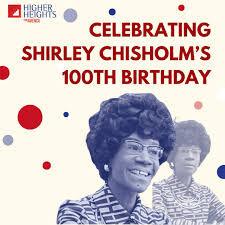
Birthdays are often a moment of both celebration and reflection. They symbolize the passage of time, offering a chance to look back on what has been and imagine what could be. As we honor what would have been Shirley Chisholm’s 100th birthday, I find myself reflecting on her life, her lessons, and the weight of the moment we are in.
I’ve been thinking a lot about what Chisholm might say to us now. For Black women, this election has left many of us grappling with grief, anger, and exhaustion. In conversations, I’ve heard the same questions echoing again and again: Why do we keep showing up for a nation that doesn’t show up for us? Why are our voices only valued when they’re needed to fix broken systems, but ignored when it’s time to share in leadership?
These are painful questions. I had to sit with my feelings the morning and weeks after the election. Like many, I questioned whether my efforts mattered, whether our collective contributions were enough. In that moment, it would have been so easy to disengage, to let the weight of rejection lead me to give up. But then I thought about my ancestors, their struggles, their resilience, and the paths they carved through unimaginable obstacles, and eventually, my thoughts turned to Shirley Chisholm. Her life, filled with defiance against injustice and a steadfast commitment to progress, reminded me of the enduring lessons she left behind: that setbacks are temporary, perseverance is essential, and the fight for justice must never waver.
Chisholm, the first Black woman elected to Congress, faced monumental barriers during her time. When she declared her candidacy for president in 1972, she encountered ridicule and rejection, not just from political adversaries but also from within her own party. Yet she pressed on, determined to pave a way for others. Her words resonate deeply: “I want history to remember me not just as the first Black woman to be elected to Congress, not as the first Black woman to have made a bid for the presidency of the United States, but as a Black woman who lived in the 20th century and dared to be herself.”
Her story reminds us that the fight for progress is never without grief. It’s an uneven road, marked by victories and setbacks, hope and despair. Yet Shirley Chisholm never let the obstacles in her path define her. Instead, she used them as fuel to keep moving forward. She knew that every step she took was part of something larger, a continuum of progress that would stretch beyond her lifetime.
Reflecting on Chisholm’s centennial, I’m reminded of another powerful quote: “Tremendous amounts of talent are being lost to our society just because that talent wears a skirt.” These words feel as urgent today as they did when she first spoke them. They remind us of the systemic barriers that continue to hold women, especially Black women, back. But they also challenge us to confront those barriers and to push through them.
I think about what Chisholm might say to us now, as we navigate the aftermath of this election. I imagine she would acknowledge our grief while reminding us not to let it paralyze us. Chisholm understood that progress is built not on the absence of pain but on the determination to keep going in spite of it. “You don’t make progress by standing on the sidelines,” she said. “You make progress by implementing ideas.”
Her centennial is not just a moment to celebrate her life—it’s a call to action. It’s a reminder that our efforts, even when they feel small or unrecognized, matter. Chisholm’s life story teaches us that the fight for justice requires persistence and courage. It demands that we show up, even when the odds are against us, and that we keep pushing, even when progress feels impossibly slow.
As we pause to reflect on the impact of this election, let us also embrace it as a time for renewal, just as our ancestors did in the face of their own struggles. Shirley Chisholm’s 100th birthday is a powerful reminder of the legacy we carry. It compels us to ask: How will we use this moment, not only to grieve what was lost, but to envision and create what is possible?
For me, the answer lies in our connection to history. Shirley Chisholm was one of the great trees, as Maya Angelou might say, whose roots run deep within us. Her life reminds us that we are part of something larger, tied to the struggles and triumphs of those who came before us. We owe it to her, ourselves, and our future to continue the work she started.
Shirley Chisholm existed. Because she did, we know that the path forward is possible. Her life shows us that grief cannot define us, and setbacks cannot deter us. Let us walk forward with the same determination she embodied, ensuring that her vision of justice, equity, and opportunity lives on in everything we do.