Editor’s Note: We reached out to our sister publication, The Washington Informer, with the idea of seeing what other news organizations have said about Gary Hines and Twin Cities master arts organization, The Sounds of Blackness. Sharing a story that we know oh so well, but through other’s lens, provides a moment to reflect on the global treasure we have in our midst.
Even writing this editor’s note brings back the vivid and joyful memory of running into Gary Hines at Kokato International Airport in Accra, Ghana in 1994. I was arriving for a 10-day mentoring project organized by the Stairstep Initiative. Hines was departing, having performed with Stevie Wonder at the PanAfrican Festival of the Arts (PANAFEST). We met beneath a banner proclaiming the PANAFEST theme for that year: The Re-emergence of African Civilization.
Sounds of Blackness have long been hailed as a group known for their stellar contributions in the gospel music world, due in part to the ensemble’s hit song, “Optimistic,” released in 1991 and which some view as their signature piece.
And while they have won a host of awards including three Grammys and four Stellar Awards, specifically for gospel music, “Optimistic” actually peaked at number 3 on America’s R&B and hip hop charts.
The vocal and instrumental ensemble from Minneapolis/St. Paul, Minnesota, formed in 1969 by Russell Knighton before he passed the baton to one of the original members, Gary Hines, in 1972, recently celebrated their 50th anniversary. And yet despite their decades of success, some fans still occasionally engage in friendly debates over the best genre with which to label Sounds of Blackness – gospel, R&B, soul, jazz or something else.
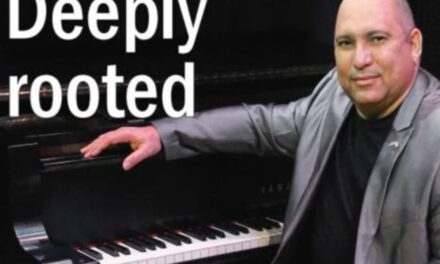
However, if you’re anxious to know the “gospel truth,” it’s best to go to the source – the current musical director and producer for Sounds of Blackness, Gary Hines, who’s also the only original member still with the group.
Hines, reflecting on their founding in January 1971 on the campus of Macalester College in St. Paul, said they wanted to represent a cultural voice which spoke for Black America – something that hasn’t changed.
“Macalester is a predominantly white institution but the college’s EEO (Equal Employment Opportunity) program made the commitment in the late 60s to provide educational opportunities for students of color,” Hines said. “But we needed organizations that would represent our cultural background and support our needs which often differed from those of white students. So, a group of African-American students founded the Macalester College Black Voices in 1969.”
“During my sophomore year in 1971, Russell [Knighton] invited me to take over as the director and we soon decided to change our name to Sounds of Blackness. God gave me the vision to follow Duke Ellington’s musical journey during which he wrote and performed spirituals, the blues and every other sound of blackness. Our ensemble wanted to continue along Ellington’s path and they embraced my vision for us to perform the full range of Black music.”
“We’re often identified as a gospel group but we actually perform every sound of blackness. It’s more than music for us – it’s a cultural institution and a movement,” Hines said.
Many of the current members, 25 in total which includes 15 singers and 10 musicians, count as the children of original members who continue the tradition which their parents first embraced. They range in age from their early 20s to 70 – the age that Hines proudly embraced on his recent birthday on May 20.
Hines and Sounds of Blackness recently released a new single, “Juneteenth Celebration,” which he said came about after President Joe Biden signed the legislation for Juneteenth last year that made it a national holiday.
“We have been in anthem mode for as long as I can remember and we’ve addressed seminal moments in American culture that have had a significant impact on Black Americans,” he said. “We’ve supported the mission of the Black Lives Matter movement through our music, responding to Donald Trump about six years ago when we referred to Black youth as ‘thugs.’ In that instance, we released ‘Royalty’ which reminded our youth that they come from kings and queens and that they are still kings and queens.”
“When George Floyd was murdered just five blocks from the building in which we rehearse, we once again expressed our reaction through song. Like Fannie Lou Hamer, we joined the many thousands of Blacks who were sick and tired of being sick and tired. Floyd’s death was nothing new to Black people. The names may be different but the murdering of our people has been going in America for 500 years.”
“When the issue of reparations began to dominate conversations last year, we wrote ‘Time for Reparations’ which was blessed with an NAACP Image Award nomination.”
“Now, with ‘Juneteenth Celebration,’ we wanted to educate African Americans after we realized that there are still a lot of Black people who are unaware of the history behind Juneteenth. Sure, we wanted the song to be soulful, celebratory and fun but it also had to be an effective teaching tool. We want people to understand the importance of Juneteenth while they’re dancing to the song and celebrating the holiday.”
The Challenge of Bringing Truth to Power
Hines said staying true to the original mission of Sounds of Blackness has often brought the group challenges and hurdles to overcome.
“Some of our anthems, while receiving critical acclaim, haven’t gotten much air play,” he said. “I can cite many program directors who have apologized for not playing our songs. They said they loved us but they didn’t want to offend their advertisers – that meant their ‘white’ advertisers. They wanted more songs like ‘Optimistic.’ But our roots are in protest songs. ‘Juneteenth Celebration,’ for us, is more representative of our roots so it wasn’t an aberration for us to return to producing the kind of song whose lyrics reflect the reason that Sounds of Blackness was initially founded,” Hines said.
As for their new release, Sounds of Blackness have chosen to refer to it as a Juneteenth anthem and not just a song for the holiday.
“We really hope and truly believe that it’s the kind of song that should be played all year long,” Hines said. “It’s not like a Christmas song because its theme is more than a reflection of a particular season. Liberation is a 365-days-a-year issue and an ongoing struggle for African Americans. We hope our fans will agree and will ask the radio programmers in their communities to play the song throughout the year so Blacks can celebrate what Juneteenth means each and every day.”
The Sounds of Blackness at Pantages Theater
The Night Before Christmas – A Musical Fantasy
Three time Grammy Award-winning Sounds of Blackness presents “The Night Before Christmas – A Musical Fantasy” Monday Dec 23. 7pm at Pantages Theater, Downtown Minneapolis.
The Sounds of Blackness delivers the sights, sounds and spirit of Christmas as never before with Rapping Reindeer, Singing Sox, Dancin’ Chitlins, Soulful Santa & Mrs Claus!
Described as “glorious and roof-raising, with show stopping music, dance costumes, and hilarious dialogue, the play features a 30 member cast and 10-piece orchestra.
A uniquely original musical play, “The Night Before Christmas – A Musical Fantasy” celebrates the true meaning and spirit of Christmas.
About The Sounds of Blackness
Source: www.soundsofblackness.org.
“FROM JAZZ AND BLUES TO ROCK & ROLL, R&B, GOSPEL, SPIRITUALS, HIPHOP, REGGAE AND SOUL, WE COLOR EACH AND EVERY “SOUND OF BLACKNESS” WITH UPLIFTING MESSAGES OF HOPE, UNITY, LOVE AND PEACE FOR ALL HUMANKIND – AND WE WORK PASSIONATELY TO ACHIEVE IT.” – The Sounds of Blackness
Since January of 1971, the Grammy Award-winning Sounds of Blackness under the direction of Gary Hines, has performing on five continents for audiences of from homeless persons, prison inmates, and orphans, to kings, queens, presidents, heads of state, and diplomats and ate at such events as the Denver Summit of Eight, the World Music Awards, national embassies and, five White House appearances.
Worldwide benefit concerts and recordings that have raised hundreds of thousands of dollars for such causes as the United Nations Telefood Concert (Jamaica), The United Nations 50th Anniversary –“People/Children of the World”, The United Negro College Fund, Scholarship America, the NAACP, The Children’s Heart Fund, the Lupus Foundation, the Opportunities Industrialization Centers, Americorps, ‘Border Babies’, the National Urban League, Hale House, HBO Comic Relief V (For The Homeless), Hurricane Katrina and tsunami fundraisers; participation in Grammy in the Schools, and countless others.
The Sounds of Blackness regularly presents theatrical productions, seminars, master classes, workshops and lecture-demonstrations on African American music, culture and history at every level from pre-school to postgraduate and, from the Smithsonian Institution to the Kennedy Center.
They educate while entertaining at schools, colleges and universities, hospitals, men’s and women’s prisons, youth correctional facilities, halfway houses, battered women’s shelters, synagogues, mosques, temples, churches, community centers, and corporations.
Sounds of Blackness has partnered with corporations such as General Mills’ “Feeding Dreams” and United Health Care’s “Do Good, Live Well” programs, to support urban programs and people.
Their clent/performance list includes General Motors, Northwest Airlines, Target Corp, 3M, IBM, A&M, American Family Insurance, the NBA, the NFL, CBS, Polygram, Disney, and NARAS.
Sounds of Blackness has partnered with domestic violence agencies and actively participates in the struggle against domestic violence through music.
Sounds of Blackness has pioneered the worldwide presence and proliferation of Inspirational Soul Music at radio, dance clubs, television, theater and film platforms.–which has in turn substantially changed and continues to change the very face of each of those entities forever. Film soundtracks include Batman and Demolition Man, Panther, House Party II, The Posse, Down in the Delta, Moses in Egypt, John Henry, First Kid, Mo’ Money, Justice, First Sunday, Precious, and The Apostle.
Sounds of Blackness has appeared/recorded with or for Quincy Jones, Stevie Wonder, Prince, Sting, Santana, Eric Clapton, Usher, Jimmy Jam & Terry Lewis, L.A. Reid & Babyface, Sir Elton John, Sir Andrew Lloyd Webber, Luther Vandross, Aretha Franklin, Anita Baker, Ashanti, Dolly Parton, Vince Gill, Lyle Lovett, Bob Dylan, John Cougar, Patti LaBelle, Earth Wind & Fire, Shirley Caeser, Yolanda Adams, Kirk Franklin, Kenny G, President Bill Clinton, Jay Leno, Lena Horne, Isaac Hayes, Little Richard, B.B. King, the Minnesota Orchestra, Johnny Mathis, Billy Crystal, Robin Williams, Jim Carrey, Whoopi Goldberg, Robert Duvall, Maya Angelou and many others.
On at least five performances global audiences exceeded one billion people: The 1992 & 1993 Grammy Awards, the 1994 World Cup, the 1996 Olympics and the 1998 World Figure Skating Championships.
Sounds of Blackness won the first of three Grammy Awards in 1992, won the Soul Train Music Award, International Time For Peace Award, seven Stellar Awards, International Dance Music Awards, 5 NAACP Image Awards and was nominated for an Emmy.
The Sounds of Blackness music helped fuel the presidential campaigns of President Barack Obama.