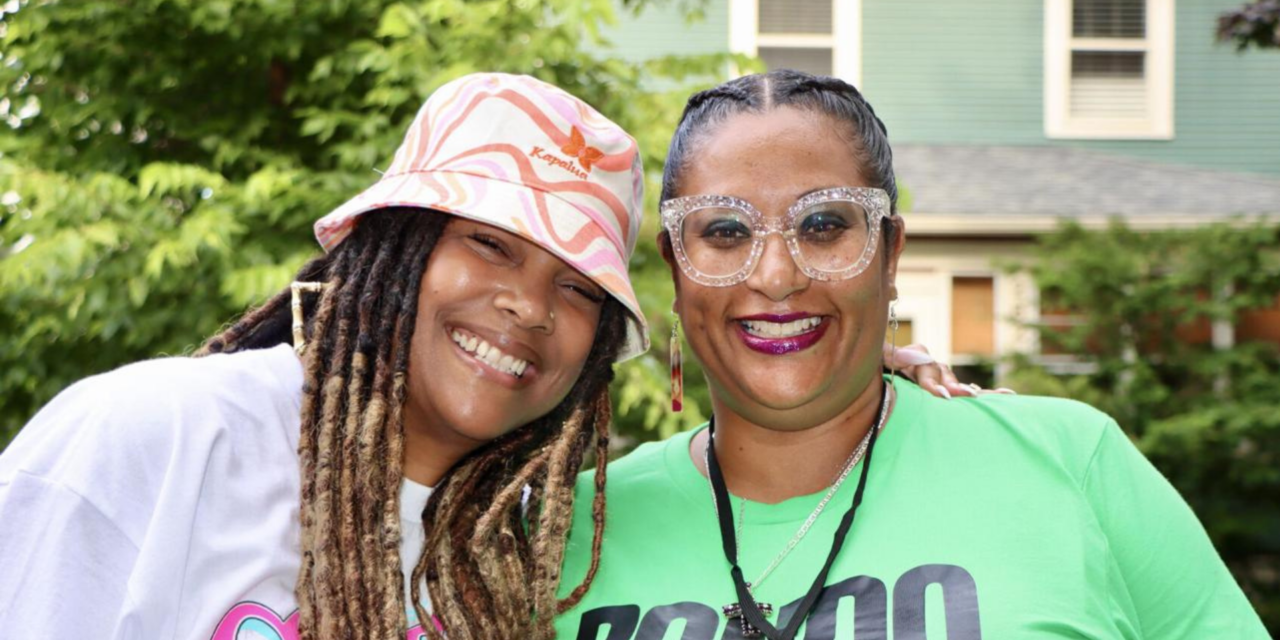
In the lead-up to Rondo Days 2025, a powerful and deeply personal conversation unfolded on Radio KFAI’s The Conversation with Al McFarlane. The broadcast, which aired just before the July 19 event, featured organizers Merina Neal and Nick Muhammad. Together, they explored the meaning behind Rondo Days, unpacked its legacy, and reflected on the long arc of Black resistance and renewal in St. Paul’s historic Rondo community.
Wednesdays on McFarlane’s show are typically devoted to themes of entrepreneurship, community wealth, and collective advancement. That particular episode focused on Rondo not just as a festival but as a mirror of what the Black community has endured and what it continues to build.
“Rondo is historic in many, many ways,” McFarlane said as he opened the segment. “And I think the finest example of a space for this conversation is in the work of the Rondo community in St. Paul.”
For Merina Neal, the conversation was not merely logistical; it was personal. She described herself as a “Rondo transplant baby” with roots running deep in the community. “I’m from a legacy family of Rondo that is off of Carroll and Fisk,” she said. “The actual commemorative plaza is right behind our family houses. I’m a Neal and proud to be part of the Neal family. So, this touches really close to home for me.”
Neal’s contributions to the festival went far beyond public-facing roles. “I’ve had the honor to do the admin stuff behind the scenes,” she explained. “Making sure we are staying on track as far as food vendors and table vendors and making sure everybody has their credentials and licenses. It’s a small but mighty team, and we’ve been working since last year to make sure everything happens.”
Rondo Days is widely recognized as one of the most significant, Black-led cultural festivals in Minnesota. It commemorates a community that was systematically displaced in the mid-20th century through the construction of Interstate 94. The disruption destroyed over 600 Black-owned homes and more than 300 Black-owned businesses. For Nick Muhammad, who also joined McFarlane’s broadcast, the festival serves as an ongoing act of remembrance and resistance.
“The short version is that there was a historic community district on Rondo Avenue,” he said. “And the city of St. Paul and the state of Minnesota decided to allow the interstate to come through and disrupt that entire corridor, displacing all of that intellectual, economic, and social capital.”
Yet Rondo Days is not only about what was lost; it is also about what endures. “The beauty of legacy for me is that the community allowed me to come in and essentially adopted me and my family,” Muhammad said. Originally from Indianola, Mississippi, which is the birthplace of blues legend B.B. King, he said Rondo reminded him of home. “It was the first space in Minnesota that made me feel like I was back home. You could go to Mr. Tilman’s Market or Earth’s Beauty Supply and see Black-owned businesses in real time, owned by families that lived right here in the neighborhood.”
Throughout the interview, both Neal and Muhammad emphasized that Rondo Days exists because of love and labor, not funding or recognition. “There’s no money when you do events,” Neal said frankly. “It has always been about community and exposing the Caribbean community and the African American community and what we celebrate – food, music, culture, religion.”
McFarlane affirmed that message and asked what culture meant to Neal, particularly in the context of raising children within the Rondo neighborhood. “For me, community is love. One love,” she answered. “Whether I’m representing my Caribbean community or my Rondo community, I eat, breathe, and live our Black communities. I reinvest my hard-earned money within the Rondo community every single day.”
Muhammad, who handled city permits and logistics, brought a similar passion to the table. “I’m basically stuck on all the paperwork. Me and Trinny C (Neal)… dotting I’s and crossing T’s,” he said. Despite the bureaucratic challenges, his motivation was clear. “This is really bigger than us. It’s about what happened before us and what’s going to happen when we’re gone.”
The conversation also traced the psychological and spiritual weight of displacement. McFarlane spoke of his own memories visiting Sunflower, Mississippi, where his grandmother lived in a shotgun house with gaps in the floorboards and geese that poked their heads through to nip at his toes. “That’s how close we are to it,” he said, reflecting on how his great-grandmother had been born into slavery. “People will tell us we should get over it. We can’t.”
Muhammad responded with a story of his own, recalling his great-aunt who was sold for a cow and how that legacy shaped his mother’s choice to name her daughter Amy. “To know those stories is kind of incredible,” he said. “I just remember my great-grandmother in my grandfather’s house. Every morning, he had to chop wood at 4 a.m. to keep the house warm.”
The interview shifted again toward the importance of memory. “Our elders are walking universities,” Muhammad said. “And a lot of us don’t want to go to school. We ignore them until we become the elders ourselves and realize we didn’t listen. Then it comes full circle.”
As the program came to a close, McFarlane asked Muhammad what he saw for the future. His response was clear and urgent. “I would encourage people to tap into their confidence in the legacy of family. Particularly Black family. Don’t underestimate the power of yourself. Don’t let anybody tell you what you can and can’t do.”
He added, “The geographic place isn’t necessarily where the power comes from. It’s the people who made the place up, and that hasn’t gone anywhere.”
The Rondo Days conversation offered more than a preview of a festival. It was a love letter to a community, a tribute to its elders, and a declaration that legacy is not only remembered but lived. Through story, laughter, and reverence, the broadcast reminded listeners that Rondo is not an echo of the past. It is a living, breathing commitment to a future built in our own names.
Watch the full conversation on Insight News’ YouTube channel: