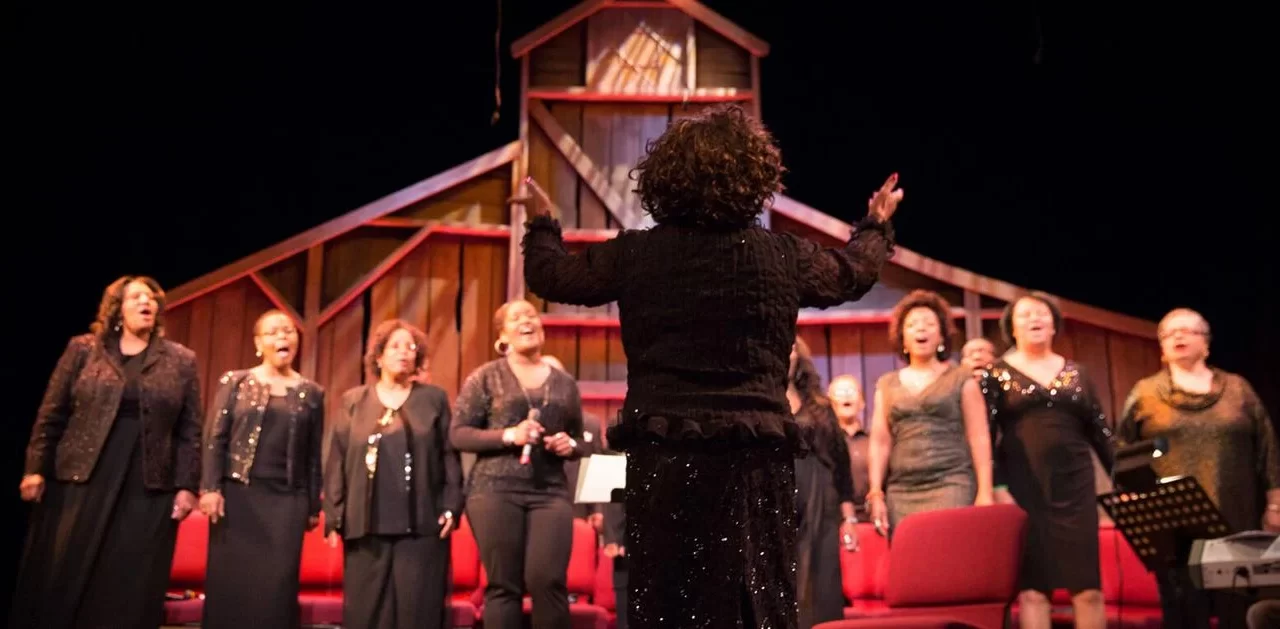
Sitting in the Penumbra Theatre on opening night of Black Nativity, I was struck by the power of tradition, not just in the story being told, but in the space where it unfolded. Penumbra Theatre, a cornerstone of the Black community in the Twin Cities, has long been a place where culture, history, and resilience are celebrated. On this night, it brought Langston Hughes’ Black Nativity to life with an energy and joy that reminded me why this story and this space matter so deeply.
For over three decades, Penumbra’s annual Black Nativity has offered audiences a reimagined telling of the Nativity story through the lens of Black gospel music, dance, and faith. This year’s production, under the direction of Lou Bellamy, was a masterclass in storytelling, reminding us of the true spirit of Christmas: love, generosity, and community.
The voices of the choir soared through the theater, lifting the audience into a shared moment of celebration. Their harmonies didn’t just narrate the story of Christ’s birth; they evoked the strength and beauty of Black culture, carried through generations in song.
The choreography, led by Marciano Silva dos Santos, brought another layer of richness to the production. The dancers moved with purpose, their bodies expressing emotions and moments that words alone could not convey. Their presence tied the narrative together, infusing the story with vibrancy and depth.
The amazing cast brought authenticity and depth to their roles, depicting not only the world of ancient Bethlehem but also the universal struggles and triumphs of humanity. Their performances resonated deeply, showing how the themes of Black Nativity — hope, love, and faith — remain profoundly relevant today.
Langston Hughes’ decision to rename the original title, Wasn’t It a Mighty Day?, to Black Nativity was a bold statement that reverberates through time. In 1961, this choice explicitly centered the Black perspective in a story traditionally told through a universalized lens. This act of cultural defiance faced resistance, even from within the production itself, as two cast members left over concerns about the divisiveness of the word “Black” in the title. Yet Hughes understood the power of naming, and his decision made Black Nativity a landmark work of cultural affirmation.
Beyond the artistry, Black Nativity felt like a celebration of the community itself. Audience members clapped and sang along to familiar Christmas songs, their engagement transforming the theater into a shared space of joy and connection. This communal experience was particularly meaningful in a year marked by political and cultural divides.
Penumbra Theatre, as the home of this production, adds profound significance. As Minnesota’s only Black professional theater company, it has long been a vital space for amplifying Black voices and telling stories that matter. To experience Black Nativity here is to feel the weight of history and the promise of progress, all in one evening.
In today’s climate, Black Nativity serves as a reminder of what unites us. It speaks to the strength of community, the power of love, and the enduring hope that light will always overcome darkness.
As I left the theater, I couldn’t help but reflect on how special it is to have a space like Penumbra in the Twin Cities, where the Black experience is celebrated, explored and preserved. Black Nativity at the Penumbra is more than a holiday tradition; it is a reflection of the resilience, creativity, and faith that define our community.
If you have the chance to see this production, don’t miss it. It will leave you inspired, uplifted, and reminded of the beauty that comes from sharing our stories and traditions. Penumbra Theatre has once again shown why it is a treasure, not just for the Black community, but for everyone who values the power of art to heal and unite.