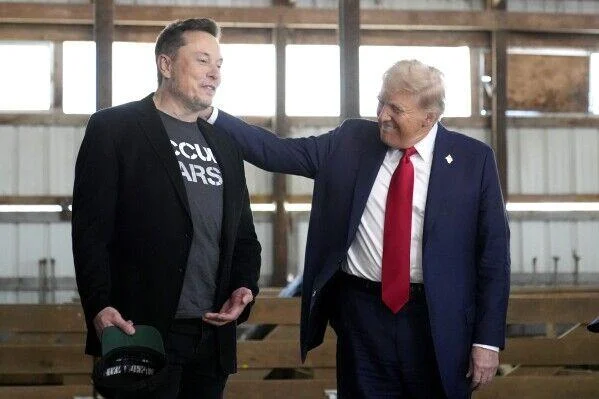
Just a few weeks ago, much of America was buzzing about the prospect of a fight between Jake Paul and Mike Tyson. Some even thought it might be the fight of the year. Little did we know that the real fight to watch, and prepare for, would be within the MAGA movement: Trump versus Musk. This brewing battle for control threatens not only the direction of the movement but also the future of democracy and civil rights in America.
As the nation watched the Republican Party flirt with shutting down the government this week, a quieter but equally troubling power struggle is starting to unfold between Donald Trump and Elon Musk. This internal battle reveals more than just a rivalry; it underscores a troubling pattern in American history where powerful figures leverage racial division and fear to secure dominance, often at the expense of marginalized communities. MAGA’s willingness to roll back civil rights advancements is not new but fits into a historical continuum of exploiting Black communities as political scapegoats to reinforce systemic inequities. This clash is not just about two larger-than-life personalities; it’s about the future of a movement that has consistently built its base by exploiting division and undermining civil rights.
For Donald Trump, a man who has long positioned himself as the undisputed leader of MAGA, Musk’s growing influence is a direct challenge to his dominance and a sign of a deeper power shift within the movement. Musk, an unelected billionaire, is leveraging his platform and wealth to carve out his own sphere of power within the movement. His ability to sway public opinion, and even legislative agendas, through provocative social media posts signals a seismic shift in MAGA’s power dynamics.
Musk’s alignment with MAGA became evident earlier this year when he made headlines for disparaging Historically Black Colleges and Universities (HBCUs) and mocking diversity, equity, and inclusion initiatives. More recently, he used his social media platform to spread baseless claims about Haitian immigrants in Ohio, alleging they were eating people’s pets. These actions are not isolated incidents; they are part of a calculated strategy to stoke fear and division for political gain. Musk’s trajectory reflects a broader MAGA agenda that seeks to weaponize race and equity issues to consolidate power.
For Black Americans, the implications of this power struggle are deeply troubling. History has shown that when powerful white men vie for dominance, Black communities often bear the consequences, enduring setbacks that reverberate across generations. From slavery to Jim Crow, from redlining to mass incarceration, power struggles among white elites have often resulted in policies and systems that disproportionately harm Black Americans, entrenching inequality and erasing progress. Each of these historical moments serves as a reminder of how vulnerable marginalized communities become when political battles prioritize dominance over justice. These historical lessons remind us that when powerful white men clash, the resulting policies and systems often deepen systemic inequities, disproportionately harming Black Americans. MAGA, rooted in white supremacist ideologies, has always gravitated toward leaders who push to roll back civil rights advancements. This is why figures like Trump, with his attacks on the Central Park Five, and Musk, with his attempts to delegitimize institutions like HBCUs, find such embrace within the movement.
The MAGA movement’s embrace of figures like Musk, who wield technological power and amplify far-right ideology, represents a grave threat to democracy and the progress achieved through decades of civil rights activism. Musk’s platform has become a megaphone for far-right ideologies, manipulating public discourse, spreading misinformation, and eroding accountability. By wielding his immense social and financial capital to spread racist narratives and xenophobic lies, Musk employs tactics reminiscent of those used by white supremacist leaders throughout history to weaponize misinformation against Black communities. His actions echo the strategies used by MAGA to suppress the voices of marginalized groups and solidify a framework of inequality. His domestic and international rhetoric intertwines to create an environment hostile to progress and equity, deepening societal divisions and undermining democratic norms.
For Black America, this moment demands clarity, vigilance, and a renewed commitment to collective action. The stakes are too high for passivity; inaction now could lead to consequences that reverberate across generations, threatening the hard-won progress of civil rights and equity. The rise of figures like Musk within MAGA highlights a broader shift toward oligarchic dominance in governance. While Trump’s policies have already inflicted harm on Black communities, Musk’s calculated political maneuvers and amplification of hate and fear represent a new, insidious challenge. This is not just a battle of personalities; it is a fight over the soul of the nation.
To ignore the trajectory of MAGA now is to risk serious setbacks for our communities. The fight for civil rights and equality has always been a relentless battle against deeply entrenched systems of power, and this moment is no different. Yet, history also teaches us that collective resistance, from the Civil Rights Movement to recent grassroots activism, has the power to challenge and overcome even the most entrenched systems of oppression. Black Americans have long been the conscience of this nation, and once again, we are called to lead in resisting the dangerous trends of division, dysfunction, and inequality. As Muhammad Ali once said, “The fight is won or lost far away from witnesses – behind the lines, in the gym, and out there on the road, long before I dance under those lights.” For Black America, this fight against MAGA’s dangerous trajectory will be won through preparation, unity, and unwavering determination, long before the spotlight is on.