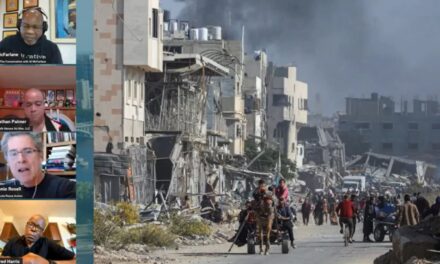
Antonio Rosell presents data on U.S. presidential election voting trends, highlighting a spike in 2020 and a drop in 2024 for the Democratic vote, sparking reflections on voter sentiment and policy implications.
In the wake of the recent US elections, The Conversation with Al McFarlane on KFAI 90.3 FM tackled the urgent themes of race, fear, and power. Host Al McFarlane was joined by guests Jonathan Palmer, Wilfred Harris, and Antonio Rosell, who provided piercing analysis on these subjects and examined how they shape both American society and global policies. The conversation, McFarlane explained, was about more than simply reacting to election results and instead, it was a profound exploration of where America stands and where it may be headed.
Opening the dialogue, McFarlane placed the concept of fear at the forefront, describing it as a primary tool used by political figures to leverage, secure and maintain power. “The Trump agenda was not about economic policy but fear,” he said. “Fear that ‘white people’—an invented term in itself—are losing power.” He asserted that this fear, embedded in white identity politics, fuels division and taps into long-standing racial insecurities. Jonathan Palmer, former director of St. Paul’s Hallie Q. Brown Community Center, supported this viewpoint, calling the current political climate a mirror reflecting America’s unresolved racial and gender biases.
Palmer then addressed Vice President Kamala Harris’s unique struggles in the 2024 election, which he said underscored America’s ongoing resistance to non-traditional leadership. “If America wasn’t ready for a Black president in 2008, it’s still not ready for a woman in 2024,” Palmer stated. He went on to highlight how Harris had a limited campaign period to distinguish herself while facing heightened scrutiny. “In a hundred days, she had to pull together a coalition. Meanwhile, Trump has been campaigning since 2020,” Palmer said, emphasizing that Harris’s bid for the presidency was mired not only by a compressed timeline but by deeply ingrained societal misogyny.
Harris, an elder in the Liberian community and an author, echoed these sentiments on the strategic use of fear in political campaigns. “Kamala was talking substance, but Trump was talking fear, and fear motivates,” he noted, referencing historical anxieties in U.S. elections, especially in Barack Obama’s 2008 run for president. Harris’s commentary drew from a personal and historical perspective, reflecting Liberia’s complex relationship with the United States, and his deep awareness of how American policies fuel global division and exploitation, particularly in Africa. “Liberia is Africa’s oldest democracy and a testament to American intervention,” he said, “but also to American negligence and self-interest.”
While discussing systemic issues, Rosell, an activist and educator, focused on U.S. foreign policy, specifically the Biden administration’s stance on Palestine. He argued that American taxpayer dollars continue to fund conflicts globally, creating disillusionment among voters who long for a more peace-oriented foreign policy. “The Biden administration’s support of the genocide in Palestine is morally repugnant,” Rosell remarked. “It’s not just a policy—it’s an erasure of people, funded by our own taxes.” He further criticized the administration’s failure to empathize with its citizens’ desire for peace, suggesting that this misalignment contributed to Harris’s lack of enthusiasm from some Democratic voters.
Together, McFarlane and his guests dissected the socio-political landscape, illustrating how fear-driven narratives affect voter perceptions and weaken public trust.
The discussion underscored the importance of addressing root causes within both foreign and domestic policies to bridge societal divides. McFarlane’s parting words to listeners were poignant: “We must be co-authors of a future where winning doesn’t require losers.” His sentiment signified a hope for a society built on collaboration rather than competition, an ideal in stark contrast to the fear-based campaigns dominating modern politics.