JAMAL AND ME
Freedom Summer
By J. Darnell Johnson
Black History Month is here, founded by Carter G. Woodson to honor the contributions we have made as African Americans in all areas of history. To kick it off, I am pleased to review J. Darnell Johnson’s work of historical fiction, Jamal and Me: Freedom Summer.
Johnson’s story is told through the lens of 11-year-old Jordan Washington. Jordan ran for sixth-grade student council president, with All-American girl Kamilla Payne as his opponent. Although his stump speech is heartfelt and substantial, he loses the election.
Meanwhile, his 9-year-old brother Jamal is excited because he has won the District 8 School of the Heart Jelly Bean Guessing Contest, qualifying him for the Region Two contest, something no Black person has achieved. Jamal has a gift—he doesn’t guess the number of jelly beans, he counts them, and he wins every time.
At the library, after Jordan registers Jamal for the contest, Jamal in engrossed in a book, The Life of Fannie Lou Hamer, checking it out along with other books on civil rights. This leads to a conversation with his Grandma Lynn about his great-grandmother Mary Jo Washington, who was never registered to vote.
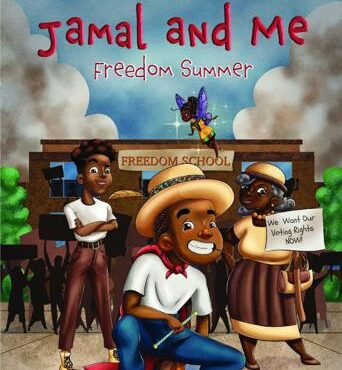
Later, on another summer night, Jamal and Jordan encounter a queen butterfly figure named Queen Azina, who has heard Jamal’s wish to meet his great-grandmother. She has the power to transport them back to the past. Their mission: to help her get registered to vote, but no one must know that they come from the future. One of the means of voter suppression back then was to have Blacks guess the number of jelly beans in a jar. She couldn’t pass that test, but it’s right up Jamal’s alley.
Through Queen Azina’s magic, Jordan, Jamal, and their dog Pharaoh are transported back to 1964 in the Mississippi Delta. They meet Fannie Lou Hamer and her family, attend the Freedom School, meet the civil rights workers who have put themselves on the line to increase Black voter registration in Mississippi. Will they find Mary Jo Washington? And when they do, will they succeed in getting her registered?
Johnson weaves a skillful, compelling story of fiction, fact, and fantasy in addressing the issue of voter suppression through the eyes of Black youth. The blatant intimidation and scare tactics of whites in Mississippi, coupled with the insidious suppression tactics such as poll taxes and discriminatory literacy tests, are brought home to Jordan and Jamal in a new way. Being 12 at the time of Freedom Summer, I remember seeing the events unfold with my family through the evening news. With Johnson’s storytelling, the reader is there and living it. At the same time, he makes the story relatable to children by drawing parallels with today.
One passage in the story that resonated with me was how the belief that the Black vote didn’t matter was addressed. Indeed, if it didn’t, why were whites going to such lengths to keep Blacks from voting? The great strength, courage, and faith it took to persevere in the face of fear and danger for the basic right to vote speaks volumes.
Jamal and Me: Freedom Summer is available through Amazon and the Minnesota Black Authors Expo website.
Kudos to J. Darnell Johnson for his awesome story, and to Mychal Batson for his superb illustrations. In the words of Fannie Lou Hamer, “We want ours, and we want ours now.” That is as true today as it was then.

W.D. Foster-Graham
W.D. Foster-Graham is a native son of Minneapolis, Minnesota. He received a B.A. in psychology from Luther College, and he was an original member of the multi-Grammy-Award-winning ensemble, Sounds of Blackness. He has also been recognized by the International Society of Poets as one of its “Best New Poets of 2003,” is a guest writer for journalist/author/entertainer Wyatt O’Brian Evans.