WHAT IF?
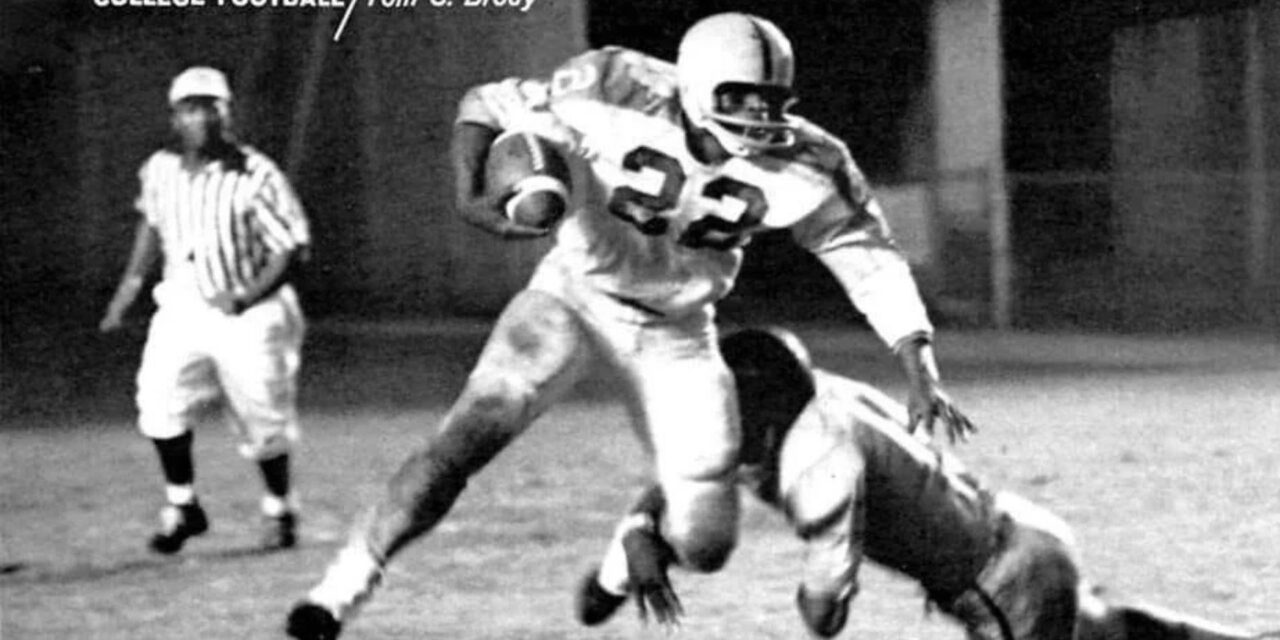
As a lover and teacher of history, I have often asked myself “what if” the dominant programs of Jim Crow era Black College football, universities like Florida A&M, Grambling, Jackson State, Morgan State, South Carolina State, Southern, Tennessee State, and Tuskegee, had been integrated into the all white SEC or ACC in the 1960’s and 70’s? True integration that is, instead of having predominantly white schools slowly recruit and subsequently dominate the enrollment of Black student-athletes after de jure segregation ended in the late 60’s?
There is a reason why each of the above mentioned HBCU’s has multiple alumni enshrined in the Pro Football Hall of Fame, and that is because in the Deep South, the ONLY options for a star Black high school football player to play local college football was to attend one of the over 100 schools that had been founded by missionaries and state legislatures during and immediately after Reconstruction to formally educate formerly enslaved Blacks.
But what if Florida A&M had found itself finally able to play the University of Florida in Gainesville, or Florida State University across the Gaines Street railroad tracks in Tallahassee, back when the talent gap was overwhelmingly in favor of the Rattlers and not the Gators or Seminoles? What if Southern and Grambling were able to enter Death Valley at LSU when their rosters were chock full of future NFL stars? What if Jackson State, South Carolina State, and Tennessee State had been able to field their dominant all-Black teams against Ole Miss, Alabama, or Tennessee’s dominant all-white teams from 1964 and beyond?
Well, the obvious answer is that we will never know because what actually happened was that instead of the top predominantly white college football teams rushing to schedule the top HBCU’s, they chose to aggressively recruit the top Black high school football players by enticing them to campuses that were far bigger and far better equipped due to the VAST funding discrepancies resulting from all white Jim Crow legislatures getting the “separate” part of public education right—but totally dissing the “equal” part that should have had HBCU’s, from 1896’s Plessy vs. Ferguson decision that codified “separate but equal,” until 1954’s Brown vs. Board of Education that overturned the same, having equal facilities, equal course offerings, and equally beautiful campuses!
That glaring lack of equal funding is why over the past several decades, multi-billion dollar legal settlements and judgments have been awarded in Alabama, Maryland, Mississippi, and Tennessee in favor of HBCU’s that got the financial shaft from their racist state legislatures for decades. In Florida, litigation has only recently begun to collect the billions of dollars that the State of Florida withheld from Florida A&M, its sole public HBCU, not just into the 1960’s, but well into the late 1980’s—when I was growing up less than three miles from the FAMU campus! Even worse, as my Morehouse Brother William Easley often reminds on social media, are the STILL disparate funding realities from Federal grants that are HEAVILY skewed in favor of predominantly white colleges and universities!
We also know that as those once segregated all-white college football teams at Alabama, Florida, Florida State, and Georgia soon turned predominantly Black by the late 1970’s and 1980’s, that the emergence of ESPN, and the infusion of major television revenue into college football, soon found HBCU’s—still enrolling their share of Black talent and being featured on ABC and CBS well into the early 80’s—shut TOTALLY out of the viewing and financial equation.
This last reality, cemented circa 1983-86, leads to where we are today, which is schools from the SEC, Big Ten and other Power Five conferences (soon to be four with the demise of the PAC 12), enrolling ALL of the best Black talent while being featured on the major networks that provide multi-billion dollar checks and NFL exposure each year—while the once dominant HBCU programs are lucky to be live streamed on ESPN3 and operate in the financial red year in and year out.
WHAT IS!
Last month, the SWAC Champion Florida A&M University Rattlers, led by Coach Willie Simmons, won the Celebration Bowl and with it, the Black College National Championship, by defeating Howard University 30-26. By the end of the month, rumors were circulating that Simmons, one of the top young coaches in the business, had received a lucrative offer to join the staff of new Duke University Coach Manny Diaz.
Last weekend, I watched (and contributed) to a feverish online effort by FAMU alumni and supporters to help keep Simmons coaching “On the Highest of Seven Hills” in Tallahassee but alas, such was to no avail as Simmons, noting in an interview with my old friend and fellow journalist Vaughn Wilson (HBCU GameDay), that his true dream is to someday lead a Power Five football team. To that end, I wish Coach Simmons and his family blessings in the years ahead at Duke—and I will continue to watch his career with great interest!
Now, as new FAMU Athletics Director Tiffani-Dawn Sykes begins what is easily the most important task in her young tenure—hiring a coach to replace the popular and prodigiously talented Simmons—the question of “what is” must be answered by not just FAMU’s alumni and supporters, but by alumni and supporters of each of the Blue Blood Black College programs that desire greater achievements and recognition in the sport.
Over the past three years, a Black College football renaissance that was sparked by Deion “Primetime” Sanders’ successful three season coaching tenure at Jackson State that included two Celebration Bowl appearances, FAMU football’s dominance that included one FCS playoff appearance—and a Celebration Bowl victory—and North Carolina Central’s dominance by winning a Celebration Bowl and appearing in the FCS playoffs, has found the HBCU “culture” front and center on ESPN game day and in television and print ads from major corporations.
Those successes have led many HBCU sports faithful, including yours truly, to wonder once more “what if?” Such questions, at least in the social media sphere, center around fierce debates about whether the top tier HBCU football teams should seek to play in the FCS playoffs against the Dakotas and Montanas, better funded predominantly white schools that dominate their same division, or whether the Celebration Bowl should be joined by another Black College bowl to create some type of HBCU playoff field that would include Division II HBCU conferences, like the SIAC and the CIAA, vying for a unified HBCU champ?
The arguments “for” and “against” are often logically sound in both of the above scenarios, but no matter where one’s personal perspective falls on the immediate future of Black College football, the ultimate truth is that sporting success takes money—lots of money—and without money, all who dream “what if,” like FAMU playing the Washington Huskies or Montana Grizzlies for the championship, are merely chasing windmills.
In fact, as I fielded personal messages and read comments —some that I’m sure were tongue in cheek—from FAMU friends who either wondered “where the money that was raised to keep Coach Simmons is gonna go now” (or whether they are entitled to refunds), the reality is that while our collective effort in such a short period of time was great, it will take that kind of effort on a sustained (read-monthly) basis IF FAMU is going to retain the highest caliber of coaching talent—and reach unsurpassed heights on the playing field. Such, I surmise, is the ultimate “what is”—cash rules everything around us, always has—always will.
My last point, the cash infusion necessity, is one that I’ve had the privilege of discussing many times with another old friend, longtime sports administrator and championship winning golf and women’s flag football coach Marvin Green, who often reminds that the ultimate role of any college or university is to educate its students!
I agree, and I further submit that sustained giving is not just important for our ball coaches, but that we must willingly donate to HBCU general funds and philanthropic organizations that put dollars in pockets (and food in mouths) of students who are working to someday become proud alumni of these hallowed institutions.
Lest we forget…
Subscribe to Hobbservation Point
By Chuck Hobbs · Hundreds of paid subscribers
“Real Politics in Real Time”
Chuck Hobbs is a freelance journalist who won the 2010 Florida Bar Media Award and has been twice nominated for the Pulitzer Prize for Commentary.

"Real Politics in Real Time"
Chuck Hobbs is a freelance journalist who won the 2010 Florida Bar Media Award and has been twice nominated for the Pulitzer Prize for Commentary.