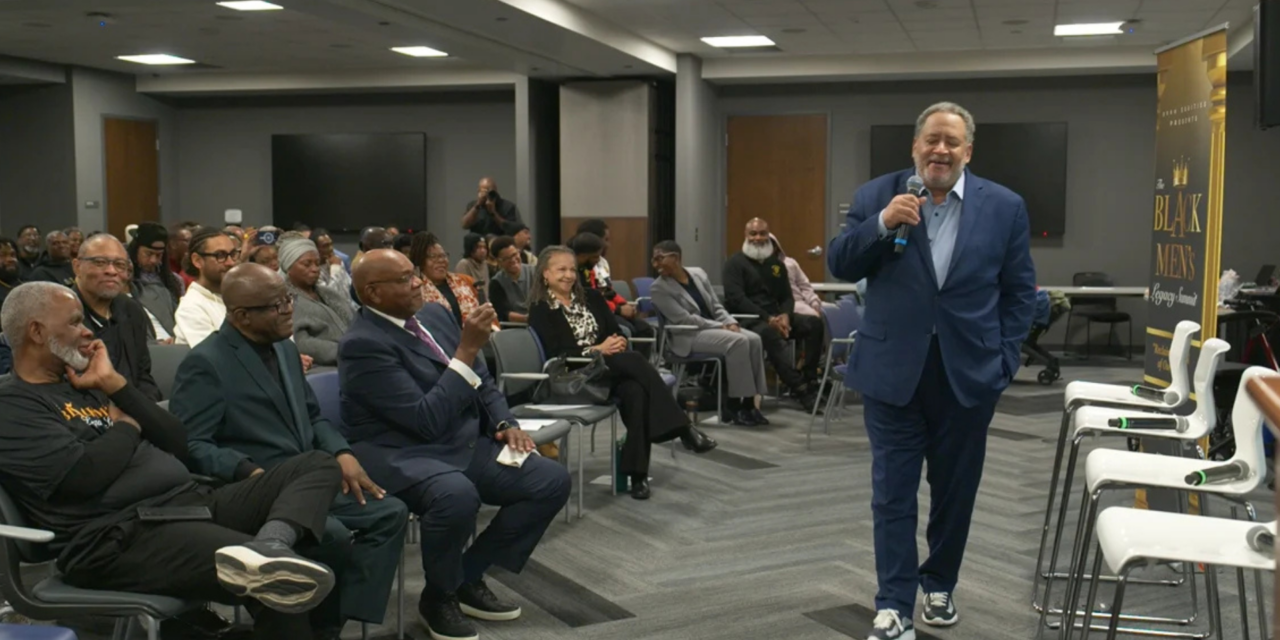
Dr. Michael Eric Dyson opened this section of his keynote at the Black Men’s Legacy Summit not with theory, but with hip hop.
“We were the capital. Black bodies were the wealth of a society that invested in us not for our advancement, but so that their culture could be advanced.”
Specifically, with Jay Z’s Legacy, a song that interrogates inheritance, responsibility, and what it means to shift a family’s trajectory when nothing has been handed down. “My parents ain’t have crap, so that shift started with me,” Dyson quoted. “My mama took her money; she bought me bonds. That was the sweetest thing of all time. Legacy.”
The choice was deliberate. Dyson is not only one of the most influential public intellectuals in America, but he is also one of hip hop’s most rigorous interpreters. A Vanderbilt University professor, ordained minister, cultural critic, and author of more than twenty books, Dyson has written extensively on Black music as philosophy, including close readings of Tupac Shakur, Kanye West, and Jay Z. His work treats hip hop not as entertainment, but as a living archive of Black political thought.
Dyson’s relationship with Jay Z is both scholarly and personal. He has interviewed him, lectured on his lyrics, and publicly defended his work as a serious contribution to conversations about capitalism, race, faith, and power. When Dyson invokes Jay Z, he is not borrowing cultural cachet. He is drawing from a shared language of survival, critique, and aspiration.
At the Summit, that mattered. The room had already spent hours talking about property, succession, and financial tools. Dyson’s keynote asked a deeper question, being what does legacy actually require of us?
We were the capital
Dyson grounded his address in history, refusing to let legacy be discussed as if it exists outside power.
“We were the capital,” he said. “Black bodies were the wealth of a society that invested in us not for our advancement, but so that their culture could be advanced.”
Legacy, in this framing, is not something Black communities failed to create. It is something repeatedly extracted, delayed, and destabilized. “So when we talk about legacy,” Dyson continued, “it cannot be a simplistic focus on building wealth outside the context of the politics that allow wealth to be built.”
He made the point plainly. Wealth does not emerge in a vacuum. Voting rights, courts, policy, and governance determine who gets access and who does not. “Politics opens the door for wealth creation,” he said. “That’s why they hold onto power so tightly.” Without political infrastructure, Dyson warned, generational wealth becomes fragile. Temporary. Vulnerable to erasure.
The paradox of being a Black man
Dyson returned repeatedly to contradiction. To what it means to live inside a body that is both feared and consumed. “Black men are in a paradoxical position,” he said. “We are despised and desired at the same time.”
That paradox, he argued, has distorted how masculinity is performed and policed. While acknowledging the harm caused by toxic masculinity, Dyson rejected the idea that it originated within Black communities. “We learned it from somewhere,” he said. “It didn’t start with us.”
What concerned him more was how easily those scripts are turned inward. Against other Black men. Against women. Against queer and trans people. “We don’t need to stand on a woman’s grave to feel tall,” Dyson said. “And we don’t need to dog gay men to prove we are men.” Legacy, in this sense, is endangered not only by external racism, but by internalized hierarchies that fracture solidarity.
Please do not demonize Black women
One of the most sustained and uncompromising sections of Dyson’s keynote centered on Black women. “Please do not demonize the women from whose wombs you emerged,” he said. He reminded the audience of an often-ignored reality: “The most educated constituency in America is Black women,” Dyson said. “And a lot of the people advocating for Black men are Black women.” Any vision of legacy that relies on resentment toward them, he argued, is structurally unsound. Families cannot be stabilized by contempt. Wealth cannot endure where respect collapses.
Legacy, for Dyson, is not only about what is passed down. It is about who is honored while it is being built.
Wealth is a means, not the end
As Dyson turned explicitly to economics, he resisted nostalgia. The labor landscape has shifted, he said. Factories gave way to service work. Automation gave way to artificial intelligence. “The context has changed,” he said. “You cannot build tomorrow’s wealth using yesterday’s assumptions.”
But adaptation without ethics, he warned, produces hollow outcomes. “The material is not the end that we seek,” Dyson said. “It is the means by which we arrive at deeper community.” Money, in his framing, must circulate. It must support families, seed institutions, and create opportunity beyond the individual. “We get that wealth,” he said, “so we can love each other better.”
Loving each other enough to build
Near the close of his address, Dyson spoke directly to Black men in the room. “We have to learn to love each other,” he said. “To believe in each other. To build together.” He challenged isolation and competition, urging a collective imagination rooted in trust. “Can you imagine,” Dyson asked, “what happens when you take what you got, I take what I got, and we join it together?” Legacy, as he framed it, is not a solo achievement. It is relational. It depends on the ability to see another Black man’s success as additive, not threatening.
Becoming worth inheriting from
When Dyson returned to the word legacy at the end of his keynote, it no longer sounded aspirational. It sounded evaluative. “Legacy is generational,” he said. “And it lasts when it is rooted in love.” By then, the Jay Z lyric had done its work. It was no longer a reference. It was a mirror. Legacy was not only about what would be left behind. It was about who Black men are willing to become while they are still here.