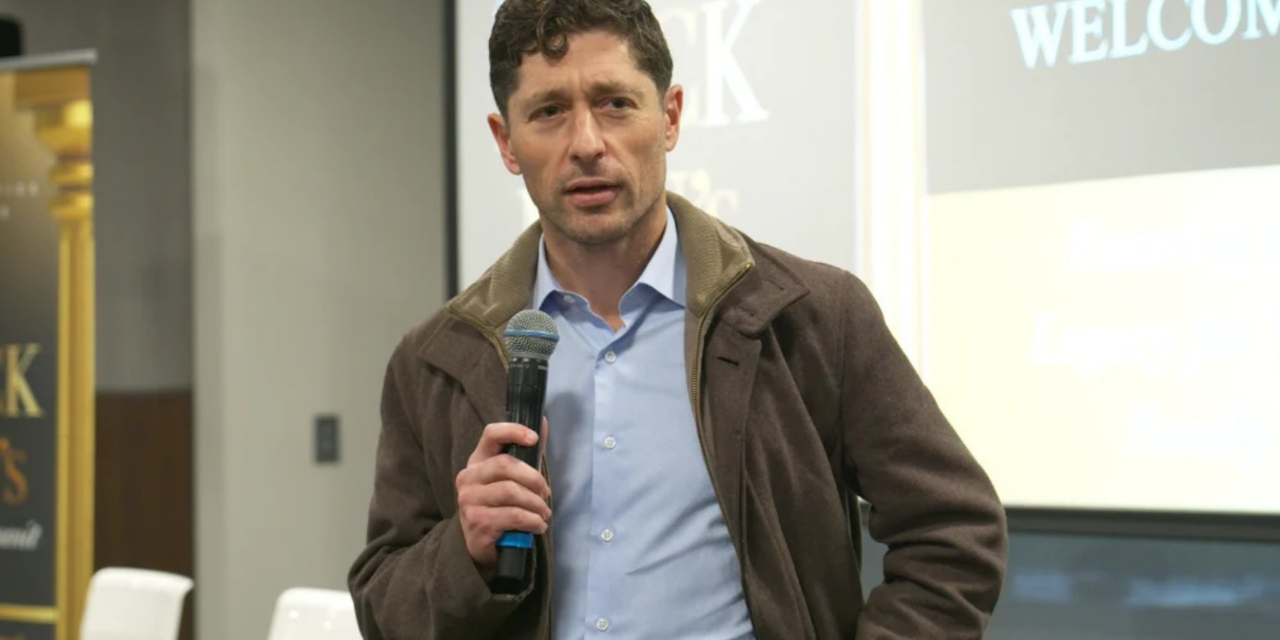
When Minneapolis Mayor Jacob Frey took the stage at the Black Men’s Legacy Summit, he did not arrive as a ceremonial guest or a distant political figure. He arrived with an argument: that the success of Minneapolis is inseparable from the economic success of Black men in the city, and that legacy, when stripped of slogans, comes down to ownership, land, and the ability to pass wealth forward.
“I am not here for my health,” Frey told the room. “I am here because I’m in charge of this city, and I realize that this city does not succeed unless you are all a tremendous success yourselves.” He framed the audience not as future leaders but as present ones, entrepreneurs, creatives, and business owners already shaping Minneapolis’ economy. From there, he turned to equity, deliberately reframing the term away from abstraction or moral appeal. “I want to talk about equity,” he said, “but not equity in the social justice sense. I want to talk about equity in terms of money.”
A City Designed to Exclude
Frey anchored his remarks in Minneapolis’ own documented history. He referenced early twentieth-century housing maps that explicitly labeled North Minneapolis a “slum for Blacks and Jews,” a designation that guided public policy, investment, and neglect for decades. These maps did not exist in isolation. They worked alongside restrictive covenants, deed clauses that legally prevented Black and Jewish families from buying property in large parts of the city. Even after such practices were outlawed by civil rights legislation, Frey argued, exclusion did not disappear. It adapted. “When you couldn’t do those things explicitly anymore,” he said, “they still happened. They just happened implicitly, through zoning codes.” Zoning laws, infrastructure placement, and land-use decisions continued to separate communities from vital assets, riverfronts cut off by highways, neighborhoods boxed in by industrial corridors, wealth routed elsewhere.
Frey placed this local history within a national framework by referencing the GI Bill, the post–World War II program that expanded homeownership and higher education for millions of Americans. While often celebrated as the foundation of the American middle class, he noted that Black veterans were largely excluded through discriminatory lending and housing practices.
When these forces are layered together, he argued, they explain why today’s wealth gaps are not accidental but cumulative.
When growth pushes people out
Frey then turned to the present-day consequences of that history. He described a familiar pattern in North Minneapolis and other historically Black neighborhoods: business owners invest their savings, time, and labor into revitalising corridors, only to be displaced once those areas become desirable. “I see people in this room right now,” he said, “people who have invested their blood, sweat, tears, time, and money into starting great businesses.” As foot traffic increases and property values rise, rents spike, and those same owners are often forced out of the spaces they helped make viable.
“That’s not fair,” Frey said plainly. “And it’s also just bad for our city.” In his telling, displacement is not only a moral failure but an economic one. Cities lose stability, continuity, and community-rooted growth when ownership remains out of reach for those doing the work.
Ownership as a policy choice
As a response, Frey highlighted Minneapolis’ Ownership and Opportunity Fund, a city-backed initiative that provides gap financing, public funding used to bridge the difference between what buyers can afford and actual property costs. The goal is not just to help business owners operate, but to help them own. “So that business owners don’t just own the business,” he said, “but own the property, the land.”
Ownership, in Frey’s framing, transforms growth into equity in its most literal sense. When values rise, owners gain wealth instead of losing access. They gain control over their future and the ability to pass something tangible to their families. “Equity in the social justice sense,” he said, “but also equity in the sense that they reap the benefit of their work.”
Shared histories, shared stakes
Frey also drew a personal connection to the moment, referencing his Jewish background and his grandfather’s stories about restricted land ownership. He spoke of how, historically, Jewish and Black communities were often barred from the same neighborhoods and institutions, and how survival sometimes depended on working together. “The only person who would sell to a Jew was a Black person,” his grandfather told him. “The only person who would sell to a Black person was a Jew.” For Frey, that shared history underscored a broader point about solidarity in a moment of rising division. He referenced contemporary political pressures, including criticism from federal officials over Minneapolis’ refusal to cooperate with deportation efforts.
“We’re staying rock solid on that,” he said, drawing applause.
In a time of heightened polarization, Frey framed legacy not as nostalgia, but as responsibility. “We’ve got a mission,” he said. “In fact, we’ve got a legacy that we all have to protect.”
Legacy as structure, not symbol
By the time Frey concluded, his message was clear: legacy is not built through rhetoric or recognition, but through policy choices that determine who is allowed to stay, own, and accumulate. He thanked the room for their commitment to Minneapolis, their families, and their neighborhoods, and emphasized partnership as the mechanism through which cities either repeat inherited harm or begin to repair it. In Frey’s narration, wealth is never neutral. It reflects the rules that govern access to land, capital, and opportunity. Change, therefore, is not a matter of charity, but of redesigning those rules so that growth finally benefits the people who have carried the city forward all along.