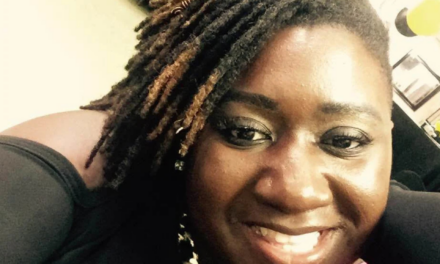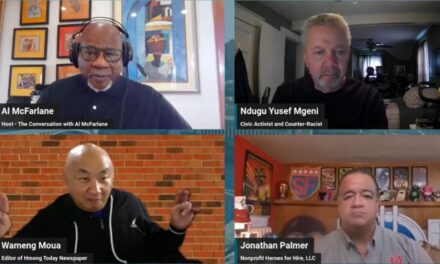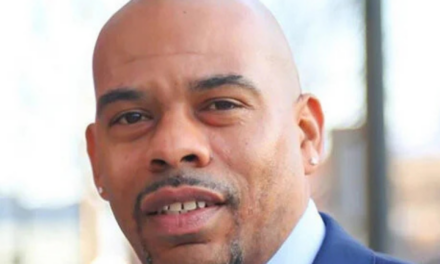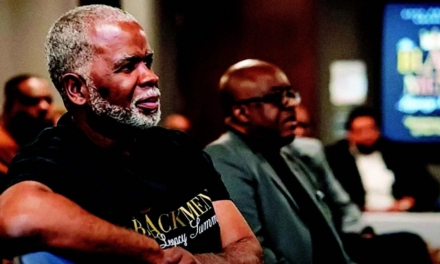
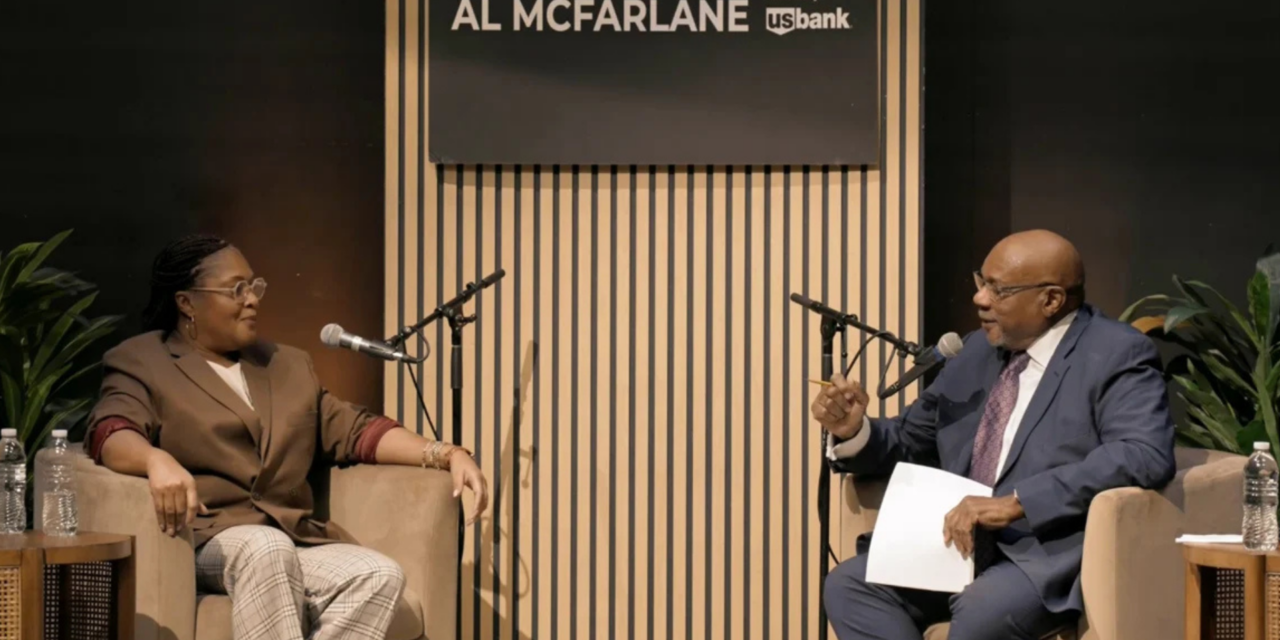
A public conversation outlining the scope, structure, and intent of the Northside Forward initiative airs 1pm Tuesday, Dc. 30 on Radio KFAI 90.3FM’s The Conversation With Al McFarlane, bringing together community members, institutional leaders, and organizers to discuss what a long-term, coordinated investment in North Minneapolis could look like in practice. The live Town Hall meeting, recorded at the Capri Theater, featured Greg Cunningham, Chief Community Impact and Inclusion Officer at U.S. Bank, introducing a wide-ranging conversation bteween veteran journalist and Insight News Editor-in-Chief Al McFarlane and Tyrize Cox, Chief Community Revitalization Officer at the African American Leadership Forum (AALF).
Cunningham opened by explaining why transparency was central to the gathering.
“One of the most important reasons that all of you are in this room today is because we want to be really open and transparent with all of you about the work that’s happening,” he said. “We want to allow all of you to have the tools that you need to actually share the information.” He added that accountability is no longer optional for large institutions.
“What people are craving is much more transparency about the work, much more accountability to outcomes,” Cunningham said. “Organizations like ours who have the power to convene have a responsibility to bring people together and to allow platforms like Insight News to help share the work.”
Cunningham emphasized that U.S. Bank’s involvement is rooted in long-term presence. “We’ve had a branch right down the street from here on West Broadway for 30 years,” he said. “This work is not new to us. Our support and investment in this community is not new. But what’s even more important is recognizing that we can’t do it alone. We need everybody in the ecosystem working together.”
McFarlane framed the discussion through history, media, and lived experience. “I live in North Minneapolis. I’ve been living here since 1973. This is my neighborhood,” he said. “We see ourselves as the information infrastructure for our community. We have a specific mission to document who we are, where we’ve been, and where we’re going.” He traced that role back decades. “The history of U.S. Bank, First Bank, and Insight News goes back to 1974,” McFarlane said. “Our first advertiser was my mentor, John Warder, president of First Plymouth National Bank. From the beginning, this work has been about documenting community life.”
When McFarlane turned the conversation to Tyrize Cox, she grounded Northside Forward in personal and professional context. “I’m a Northside kid,” Cox said. “I was born on the Northside. I didn’t grow up here, but when I moved away and came back in my twenties, I realized coming back to Minneapolis, where my roots were, is where I wanted to be.” She explained how her academic training shapes her approach. “My undergrad is in sociology. I thought I was going to be a social worker,” Cox said. “Then I went back to get an MBA. The work that I do needs both my head and my heart. I need to have a heart for the people, but I also have to make sure the math works and that the outcomes are what we intend them to be.”
Cox described Northside Forward as a structured, community-built plan. “Northside Forward is a comprehensive plan that aims to invest $1.5 billion in North Minneapolis over ten years,” she said. “It was put together by about 200 community members, community leaders, and faith leaders. It’s not a lot of fluff. It has six goals, 25 strategies, and 73 action steps.” Those goals include thriving corridors, cradle-to-career education, housing, health and wellness, civic engagement, and employment. “When we talk about thriving corridors and nodes,” Cox said, “we’re talking about Broadway and Lowry being places where people want to spend their time and their dollars. Commerce, restaurants, retail, movement.”
Housing, she noted, is clearly defined. “There is a concrete number. I believe the number is 1,800 housing units,” Cox said. “That includes single-family housing, duplexes, higher-density housing, homeownership, and senior housing. We realized that in the next ten years, we will not have enough housing to meet the community’s needs if we don’t act intentionally.”
On civic engagement, Cox emphasized clarity and accountability. “Your elected officials have an accountability to you,” she said. “But we also want people to understand what they’re being promised. What does that mean in your life, at your address? Engagement shouldn’t start right before an election.”
McFarlane pressed on the issue of perception. “If people believe there is no value here, their actions and public policy will reflect that,” he said. “So, the question becomes, how do we intentionally change the narrative?”
“The way we change it is how we tell our story,” Cox responded. “How well, how often, and how loudly we tell the stories about the good things that are already happening in North Minneapolis.” She named long-standing organizations and leaders as evidence of existing momentum. “People like Doris Baylor, organizations like NEON (Northside Economic Oportunity Network) , Summit Academy, PPL (Project for Pride In Living), Minneapolis Park Board partners…” Cox said. “They’ve been doing amazing work for a long time. This is an opportunity to do it together, faster, more efficiently, and louder.”
The conversation also acknowledged systemic barriers. “There was a period when nonprofits were competing because resources were thin,” Cox said. “I do think there was some intentionality in how funding was structured. That makes collaboration even more important now.”
McFarlane returned to the importance of scale. “When we attach billion-dollar numbers to our needs and our potential, we shift the conversation,” he said. “We stop talking about scraps and start talking about what is actually necessary.”
Cox agreed. “Naming that number creates accountability,” she said. “It also gives our community permission to dream bigger about what we deserve and what we’re capable of.”
As the broadcast concluded, McFarlane closed with words he had returned to throughout the conversation. “Victory is both imminent and inevitable,” he said. “We are on track. We are building the freedom that we seek, building the democracy, building the vitality, and we are going to save ourselves, our families. We’re going to save humanity in the process.”